


Zero-Day Vulnerability Protection: How to Secure When There's No Patch Yet
Strategies, methods, and techniques for the exploits that arrive before the patch does
Zero-day vulnerability protection is a baseline requirement for network, endpoint or cloud security.
In 2025, Google's Threat Intelligence Group tracked 90 zero-day vulnerabilities under active exploitation, 48 percent of them aimed at enterprise infrastructure.
Mandiant's 2026 research puts mean time-to-exploit at an estimated negative seven days, attackers routinely weaponize a vulnerability before the vendor makes a patch available.
For IT security and security operations teams, this changes the premise entirely.
You cannot patch a vulnerability that has not been disclosed, and you cannot write a detection signature for an exploit no one has seen yet.
Zero-day vulnerability protection has to work by other means. Reducing what is exposed, watching for what a patch cannot yet tell you, and closing the gap between patch release and patch adoption faster than attackers close the gap between disclosure and exploitation.
What makes a zero-day different, and why signature-based defense fails
A zero-day vulnerability is a flaw the vendor does not yet know about. That sounds academic until it's mapped against how most security tooling works.
Antivirus software, intrusion detection systems, and legacy vulnerability scanners all depend on a known signature, a known pattern, or a known CVE entry.
A zero-day has none of these at the moment it is used. That is precisely why it's the most liked by attackers who need to get past defenses.
The 2026 data show where this plays out. [1] [2]
Edge devices, VPN gateways, firewalls, and identity platforms accounted for more than half of enterprise-targeted zero-days last year, largely because these systems sit outside conventional endpoint detection coverage while remaining internet-facing at the same time.
Ivanti Connect Secure, Cisco's SD-WAN stack, and Microsoft Office and SharePoint have all carried actively exploited zero-days.
A zero-day protection strategy that assumes remediation happens only when the patch is available, by definition is bit dangerous. The posture must hold even when no patch and no signature exist yet and that posture is the real subject of zero-day vulnerability protection.
Let’s look at two windows. One is Zero-Day window and other N-Day window.
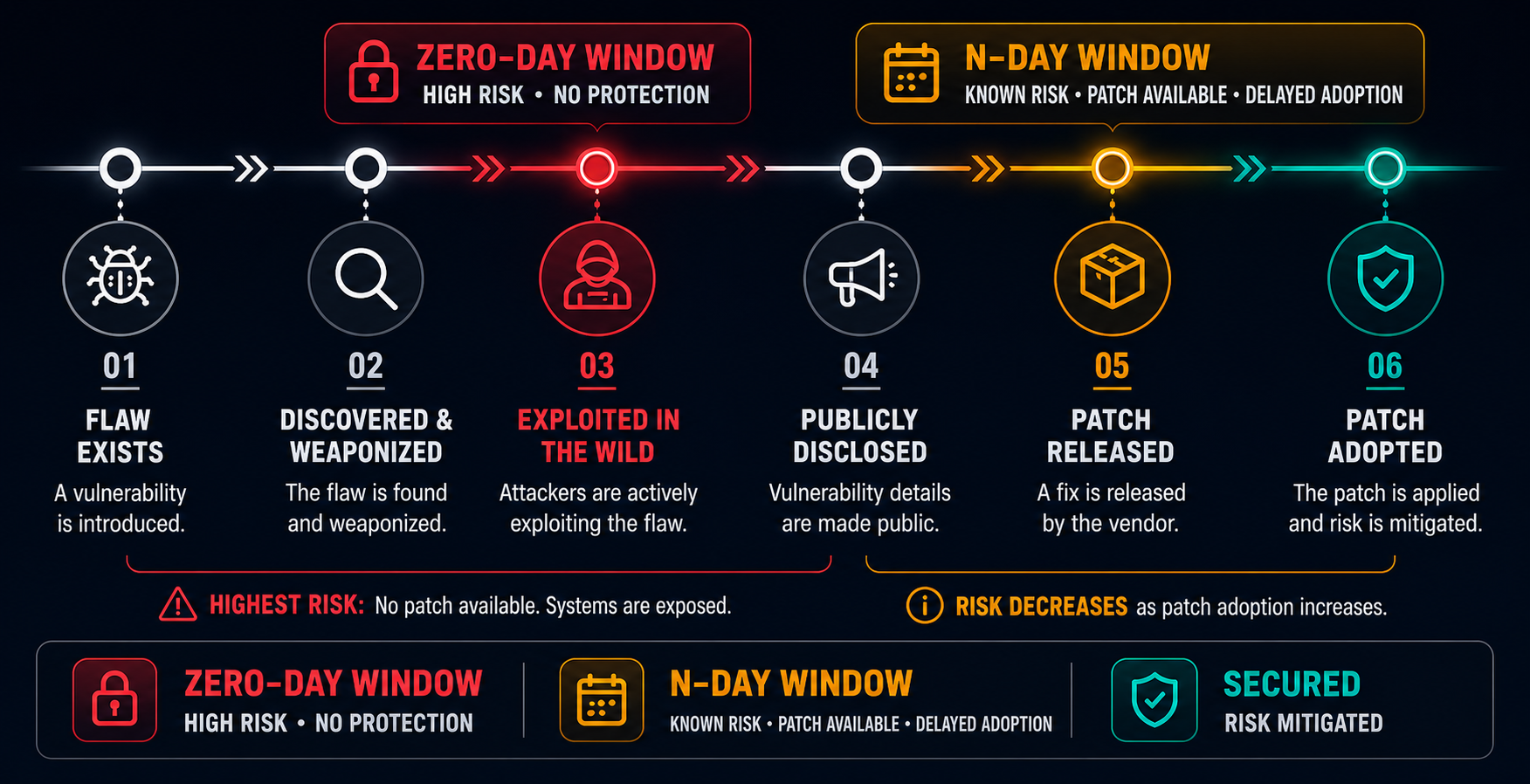
The zero-day window (red) appears before public disclosure, only exposure reduction and behavioral detection can help here.
The n-day window (amber) appears the moment a patch is available and closes only when patch is deployed, currently averaging 60-plus days for critical vulnerabilities.
Most breaches happen inside one of these two windows.
Zero-day vulnerability protection strategies
Effective zero-day vulnerability protection strategies focus less on detecting exploit and more on reducing what attackers can use.
Let us look at a few.
- Reduce attack surface
Every internet-facing service, unused port, legacy protocol, and unmanaged endpoint is a candidate for the next zero-day. Teams with an accurate inventory of exposed assets can cut down the assets having zero days - Prioritize by exploitability and exposure, not CVSS alone
CVSS scores say nothing about whether a vulnerability is being actively exploited, internet-reachable, or sitting on a business-critical asset. VulnCheck's 2026 research found CVSS-only triage misses roughly a third of vulnerabilities already confirmed exploited in the wild, because the National Vulnerability Database can't score incoming CVEs fast enough to keep pace. - Assume the patch will be late
If there is no patch, you need to defend anyway. You can edit configuration files, block applications, uninstall applications, make changes in registry, change file system permissions, make changes to application configurations, ensure network segmentation, use controls like network segmentation, and application allowlisting buy time until the patch arrives, without waiting on the vendor patch releases. - Layer detection around behavior, not signatures
Behavioral and anomaly-based detection catches zero-day exploitation because it doesn't need to recognize the exploit itself, abnormal behavior due to the attack such as unusual process trees, lateral movement, credential misuse.
None of these four can replace patching. They exist because patching a zero-day is, by definition, impossible to fix until a patch exists, and each strategy is what keeps an organization secured during that gap.
Moreover, no single control can cover the entire attack cycle. For E.g., Attack surface reduction and prioritization act before an exploit runs. Behavioral detection acts while it runs. Incident response act once it's known. You need to have all the layers to ensure better control in mitigating the risk.
Common zero-day vulnerability protection methods
- Continuous asset and exposure visibility
You can't protect an asset you don't know exists. Shadow IT, unmanaged cloud instances, and forgotten applications, open ports, unwanted processes and services, non-standard configurations, unauthorized devices, outbound connections, are recurring zero-day entry points. - Exploit-based and exposure-based prioritization
Prioritize vulnerabilities using real-world exploit intelligence, such as CISA's Known Exploited Vulnerabilities (KEV) catalog, EPSS scores, and your organization's exposure data. This ensures the vulnerabilities most likely to be exploited are fixed first, not just those with the highest CVSS scores. - Network segmentation and microsegmentation
Limiting lateral movement means a zero-day that compromises one host or edge device can't reach the rest of the environment. With edge devices and VPN gateways the single largest exploited category in 2025, segmenting them from core infrastructure is baseline, not optional hardening. - Application allowlisting and least privilege
Only approved applications can execute, and users and processes are limited to the minimum permissions they require. This reduces the attack surface and limits the impact of exploits, even if an attacker gains initial access. - Behavior-based EDR / XDR detection
Endpoint and extended detection tools that detect anomalous process behavior, unauthorized memory access, and unusual privilege escalation catch zero-day exploitation without needing a known indicator of compromise. This is arguably the single most effective zero-day vulnerability protection method available today, because it operates on behavior, which doesn't change even when the exploit code does.
Prevent approach for improved zero-day vulnerability protection
The prevent approach offers an enhanced way to deal with zero days. It helps you to see what's exposed, know what to remediate first, and act on it fast, in a continuous manner. This integrated approach helps in better zero-day protection, even when there's no patch yet.
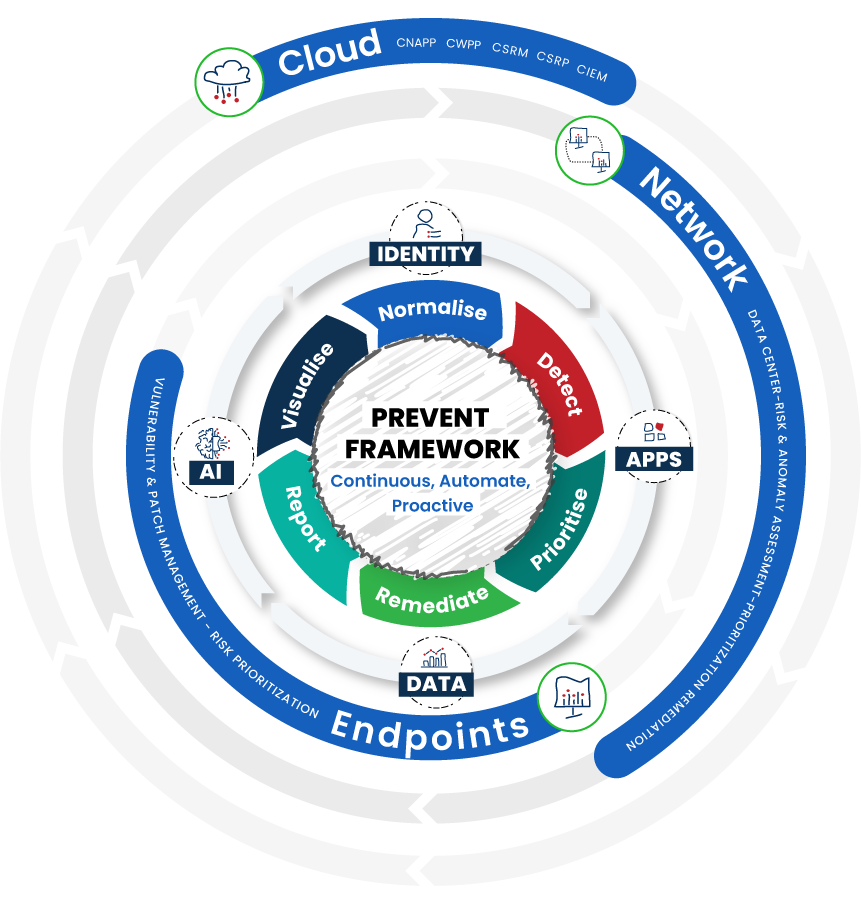
Visualize and Normalize
Collate and map every asset, endpoint, and cloud instance into one unified inventory. Normalize different types of vulnerability data such as CVEs, misconfigurations, exposures into a single, comparable data model to offer a single normalized view to enable exploitability-based prioritization possible in the next step.
Detect and Prioritize
Layer behavioral detection on top of scanning, since a zero-day has no signature to catch in the first place. Prioritize using SSVC based on exploitability, exposure, and business impact and not CVSS severity alone. This shows the vulnerabilities attackers can actually reach and exploit, not just the ones with the high-risk score.
Remediate and Report
Remediate security weakness rapidly with compensating controls when no patch exists yet with segmentation, allowlisting, configuration changes. Automate remediation for the vulnerabilities confirmed as actively exploited or KEV-listed, so remediation time isn't impacted by manual patch deployment. Report on real risk reduction, not just vulnerabilities remediated.
Zero-day vulnerability protection techniques
Mature security operations teams share five recurring practices:
- Continuous exposure scanning over periodic scanning. Periodic scans miss assets that appear between scan schedules such as new cloud instances, temporary VPN access, and contractor devices.
- Total awareness on how to deploy a compensating control. if the team has a pre-approved playbook for deploying a segmentation rule act in hours, they will be act quicky, rather than act post incident.
- Implement patch automation instead of manually deploying a patch. This reduces the remediation window time immediately, rather waiting for it to be deployed.
- Zero-day disclosures typically arrive with some indicator of compromise within days, even if a patch takes longer. Teams which use unified security intelligence can act immediately before the compromise becomes a breach.
- Practice for zero-day attacks specifically. Ransomware and phishing drills don't cover this case, because you don't know how the attacker got in and you can't fix it right away. Practicing this exact situation is what helps your team react fast when it really happens.
Zero-day vulnerability protection methods 2026
Three ways that will define what zero-day vulnerability protection methods look like in 2026, distinct from the playbook that worked even two years ago.
- AI is reducing the timeline further
AI is compressing the timeline further, which makes prevention the only strategy that still works.AI-assisted vulnerability research and exploit development are shortening the path from flaw discovery to weaponized exploit.
The time to exploit is no longer measured in weeks. Detection-first approaches lose ground every time this window shrinks, because there's less time to catch an exploit after it's already running.
A prevent-first posture such as reducing exposure before the flaw is ever found, rather than reacting once it's exploited, is what holds up as this timeline keeps compressing. - AI systems are now the attack surface
AI systems are now the attack surface, not just the attacker's tool, which widens what prevention has to cover.
Shadow AI agents deployed by business units with broad, ungoverned permissions, and prompt-injection attacks that require no user interaction, represent a genuinely new vulnerability class in 2026, one where the AI agent itself becomes the exploit path.
Security strategies that only cover traditional software and infrastructure now have a gap. Prevention needs to extend to AI agent exposures, controlling what they can access before that access becomes the next zero-day entry point. - Regulatory pressure is compressing remediation timelines
CISA's Known Exploited Vulnerabilities catalog now carries federal remediation deadlines as short as two weeks from listing, a cadence increasingly mirrored by cyber-insurance requirements.
Reactive protection methods built around a delayed patch cycle can't meet that deadline. By the time a flaw is confirmed exploited, two weeks is barely enough to test and deploy a patch.
A prevent-first approach is what actually keeps pace with this cadence: reducing exposure and remediating them before a vulnerability land on the KEV list.
To be ahead in the AI era, you need to treat vulnerability and exposure management as a continuous activity. It should not be treated as a quarterly/monthly/weekly scan.
Choosing the best zero-day vulnerability protection solutions
- Unified visibility across endpoint and cloud
A zero-day can be in endpoint, network or cloud. So, your visibility needs to cover all three. Exploit-based and exposure-based prioritization, not CVSS-only scoring. The best zero-day vulnerability protection solutions use unified security intelligence of more than 200,000+ security checks, which covers live exploit intelligence and exposure context rather than ranking purely by static severity. - Use compensating controls to mitigate risks fast
You must mitigate the risk of a flaw by using compensating controls, without waiting for patch. This ensures you are secure during the time between when a vulnerability is found and when it is patched. - Remediation speed and automation
Continuous vulnerability and exposure management platforms can rapidly remediate critical and actively exploited vulnerabilities and reduce the remediation timeline. - Continuous security operations, not weekly or monthly assessment
With the exploitation window now measured in single days, any platform built around weekly or monthly scanning is architecturally weak. You need a continuous vulnerability and exposure management platform. - Strategically fits in with existing operations
The best platform is the one a security operations team can run continuously, integrated into existing workflows, not a separate tool.
Key Takeaway on Zero-Day Vulnerability Protection
Zero-day vulnerability protection isn't achieved with a single tool or a single control.
It's the discipline of staying secure when there are no patches and no existing signature by reduced exposure, behavioral detection, compensating controls, and a remediation workflow fast enough to close the gap once a patch is available.
2026 has made this unambiguous: exploitation now regularly precedes disclosure, and the enterprises treating zero-day protection as a continuous operational discipline are the ones who will remain secure when the next one appears on their infrastructure.
Mitigate Zero-Day Vulnerability Risks with Saner
Saner is a continuous, automated, and integrated platform that can rapidly identify and remediate vulnerabilities, including mitigation of zero-day risks. It supports major operating systems including Windows, Linux, and macOS, along with more than 550 third-party applications.


