

Saner Container Orchestration Risk Prioritization (CORP)
Know Which Kubernetes Risks to Act On First
Correlate findings across clusters, namespaces, workloads, and resources, and let CISA’s own decision framework tell your team what to act on, what to attend to, and what can wait.

How it works
Powered by Prevention
Saner CORP is part of Saner COSP, bringing SecPod’s prevention-first security approach to Kubernetes posture management and orchestration across on-premises and managed Kubernetes environments.
How it works
Powered by Prevention
Saner CORP is part of Saner COSP, bringing SecPod’s prevention-first security approach to Kubernetes posture management and orchestration across on-premises and managed Kubernetes environments.
Your first 30 days with Saner
From deployment to measurable risk reduction — here is what to expect.

Kubernetes findings enter a prioritized view
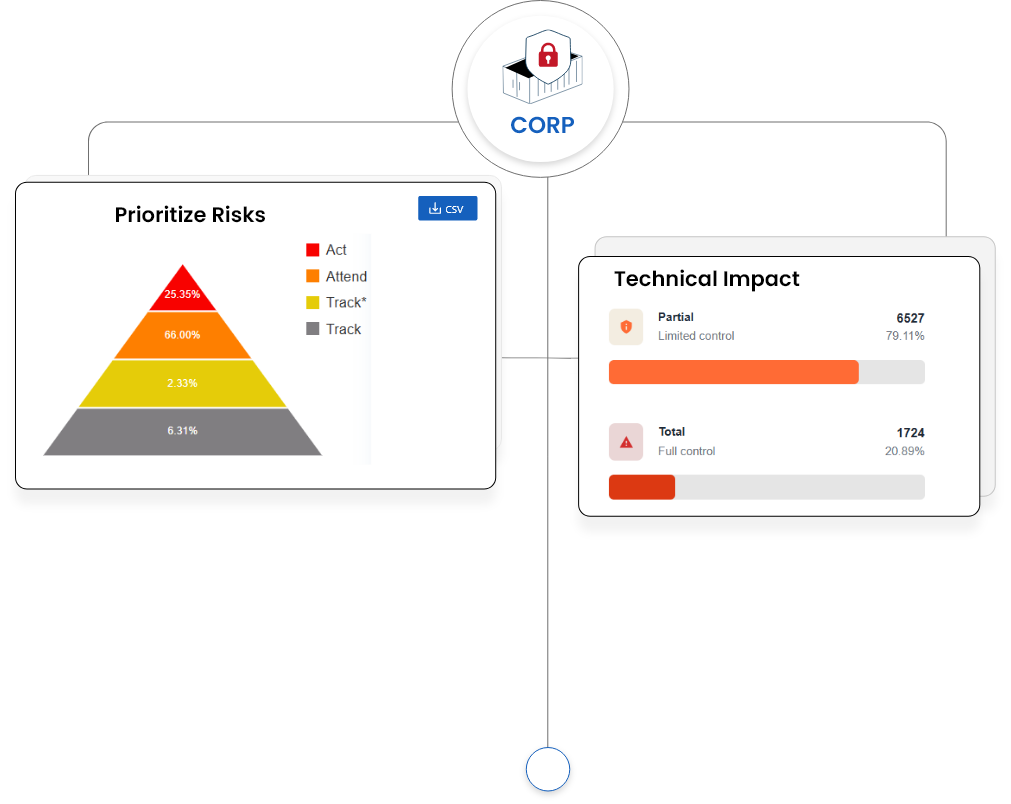
Saner CORP correlates supported findings with affected clusters, namespaces etc. Risks are categorized by Act, Attend, Track*, and Track categories for easy prioritization.
Technical findings gain operational context
Teams add mission impact and resource priority where needed. MITRE ATT&CK mapping adds adversary context to relevant findings, helping reviewers tell urgent work from risks that can just be monitored.
Prioritization becomes part of remediation operations
Security and platform teams use shared action categories to review findings, assign work, and move supported risks into CORM workflows for better risk reduction.
Key Features
Everything you need to stay ahead of threats.
Prioritize Risks Based on Action Categories
Sort every misconfiguration into Act, Attend, Track*, or Track using CISA’s own model.
Saner CORP uses the CISA Stakeholder-Specific Vulnerability Categorization decision tree to classify risks into four action categories. Act flags risks needing immediate remediation, Attend calls for timely investigation, Track* requires closer monitoring, and Track covers lower-priority risks reviewed on standard timelines. This moves teams beyond counting misconfigurations toward acting on what actually needs attention first.
Map Risks to MITRE ATT&CK for Threat-Informed Defense
See the tactics and techniques behind every risk, not just the misconfiguration itself.
Every identified risk is mapped to relevant MITRE ATT&CK tactics, techniques, and mitigations, showing how an adversary could exploit it and what defensive action addresses it. This turns a container misconfiguration into real attacker context, helping teams prioritize and remediate with a clearer picture of actual exposure.
Assess Mission Criticality Across Core Security Domains
Factor in what a resource means to the business, not just how severe the finding is.
A configurable questionnaire assesses security practices across cluster security, access and identity management, workload security, network and service exposure, node and infrastructure security, and configuration and compliance. Resources and namespaces are classified as business-centric, data-centric and publicly-accessible.
Correlate Findings From COPM and COEM With CCE Enrichment
Get one prioritized risk view instead of separate lists from separate tools.
Prioritized Risks consolidates findings from Container Orchestration Posture Management and Container Orchestration Entitlement Management, then enriches them with CCE data covering exploitation probability, automatable potential, and technical impact.
Remediate Directly From Every Risk View
Move from a prioritized risk straight into a fix, without leaving the workflow.
Every risk view, from the Prioritized Risks list to the MITRE ATT&CK mapping table, includes a Fix action that redirects directly into Saner CORM to begin remediation. This keeps risk prioritization and remediation on the same path instead of handing off between disconnected tools.