

Saner Container Orchestration Entitlement Management (COEM)
See, Identify and Manage Excessive Permissions Across Kubernetes
Map Kubernetes identities to their RBAC entitlements, identify excessive permissions with supporting evidence, and review security-related activity across standalone, on-premises, EKS, AKS, and GKE environments.

How it works
Powered by Prevention & USI
Saner COEM is part of Saner COSP, bringing SecPod’s prevention-first security approach to Kubernetes posture management across on-premises and managed Kubernetes environments.
How it works
Powered by Prevention & USI
Saner COEM is part of Saner COSP, bringing SecPod’s prevention-first security approach to Kubernetes posture management across on-premises and managed Kubernetes environments.
Your first 30 days with Saner
From deployment to measurable risk reduction — here is what to expect.

Kubernetes access relationships become visible
Saner COEM brings Kubernetes identities, RBAC relationships, permissions, and entitlements into a connected view. Teams can begin tracing how users, groups, roles, cluster roles, and service accounts gain access to resources.
Excessive-permission reviews gain evidence
Teams review excessive-permission findings with supporting evidence and examine related activity. Findings that require corrective work can be separated from access that is expected for the identity's function.
Entitlement governance becomes repeatable
Relationship analysis, evidence review, activity monitoring, reporting, alert follow-up, and CORM-connected remediation become part of a consistent process for reviewing Kubernetes access and addressing supported findings.
Key Features
Everything you need to stay ahead of threats.
Kubernetes Identity and Entitlement Visibility
Bring Kubernetes users, groups, roles, cluster roles, service accounts, permissions, and entitlements into a consolidated access view. Teams can examine how identities are configured across supported environments, understand the access assigned to each entity, and reduce the manual effort required to collect RBAC information from individual clusters.
Visual RBAC Relationship Mapping
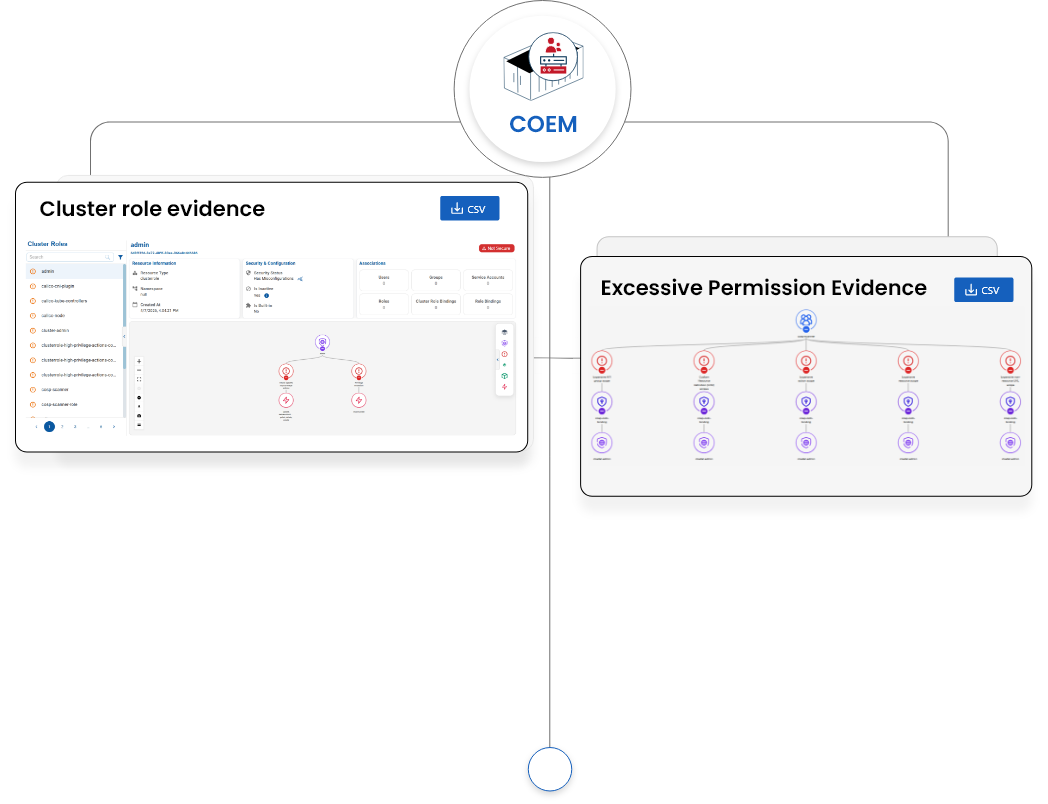
Use the built-in Details Map to visualize how identities connect with roles, entitlements, permissions, and accessible resources. The relationship view helps teams trace how access is granted, examine effective permission paths, and identify unexpected connections that may be difficult to detect in raw RBAC configuration data.
Evidence for Excessive Permissions
Associate excessive-permission findings with supporting evidence that identifies the unnecessary access contributing to each result. Reviewers gain the context needed to understand why an entity was flagged, assess the assigned permissions, and determine whether the access should be retained, reduced, or investigated further.
Security-Related Activity Logs
Capture key actions and events across Kubernetes environments with contextual information for investigation and review. Teams can use the logs to examine activity that may relate to threats, policy violations, operational issues, incident response, access governance, or audit requirements without relying on disconnected event records.
Custom Report Templates
Create report templates focused on the identities, entitlements, permissions, relationships, and activity data relevant to a specific audit or compliance requirement. Teams can tailor the information presented to security, governance, or audit stakeholders instead of manually restructuring a generic report for each review.
Entitlement Alerts and CORM Integration
Receive Identity Entitlement Management Alerts when configured access conditions are detected and require attention. Supported findings can move into Saner CORM remediation workflows, giving teams a connected path from entitlement monitoring and investigation to planned corrective work.