


Why risk-based vulnerability management begins by reducing uncertainty
Uncertainty is the real security problem
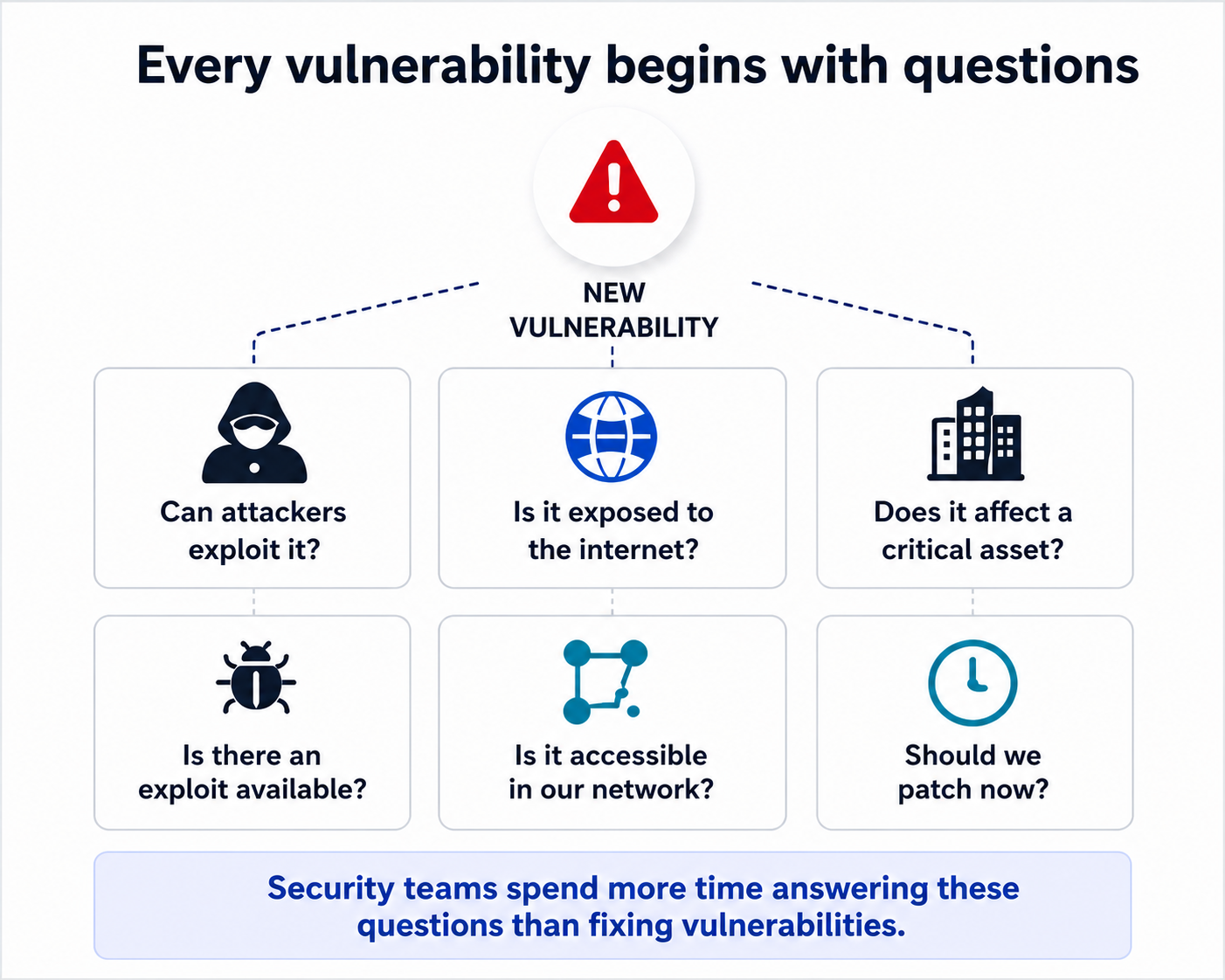
A vulnerability does not tell a security team what to do.
Before acting on vulnerability, teams must understand whether vulnerability is exploitable in their environment, whether the affected asset is exposed through a attack path, whether there is exploit available, how critical the asset having the vulnerability is to business operations, and whether remediation can be performed safely.
These unanswered questions can create uncertainty, and uncertainty delays remediation.
The primary objective is to systematically eliminate uncertainty by enriching every vulnerability with exposure context, threat intelligence, asset criticality, and decision frameworks such as SSVC.
When uncertainty is reduced, remediation decisions become proof-based, continuous rather than reactive.
Risk-based vulnerability management depends on understanding both the likelihood and the business impact of exploitation.
Those factors cannot be measured reliably while critical information about exposure, exploitability, and business context remains unknown.
Reducing uncertainty is the foundation of Risk-Based Vulnerability Management and the prerequisite for Continuous Exposure Remediation.
Risk Cannot Exist Without Certainty
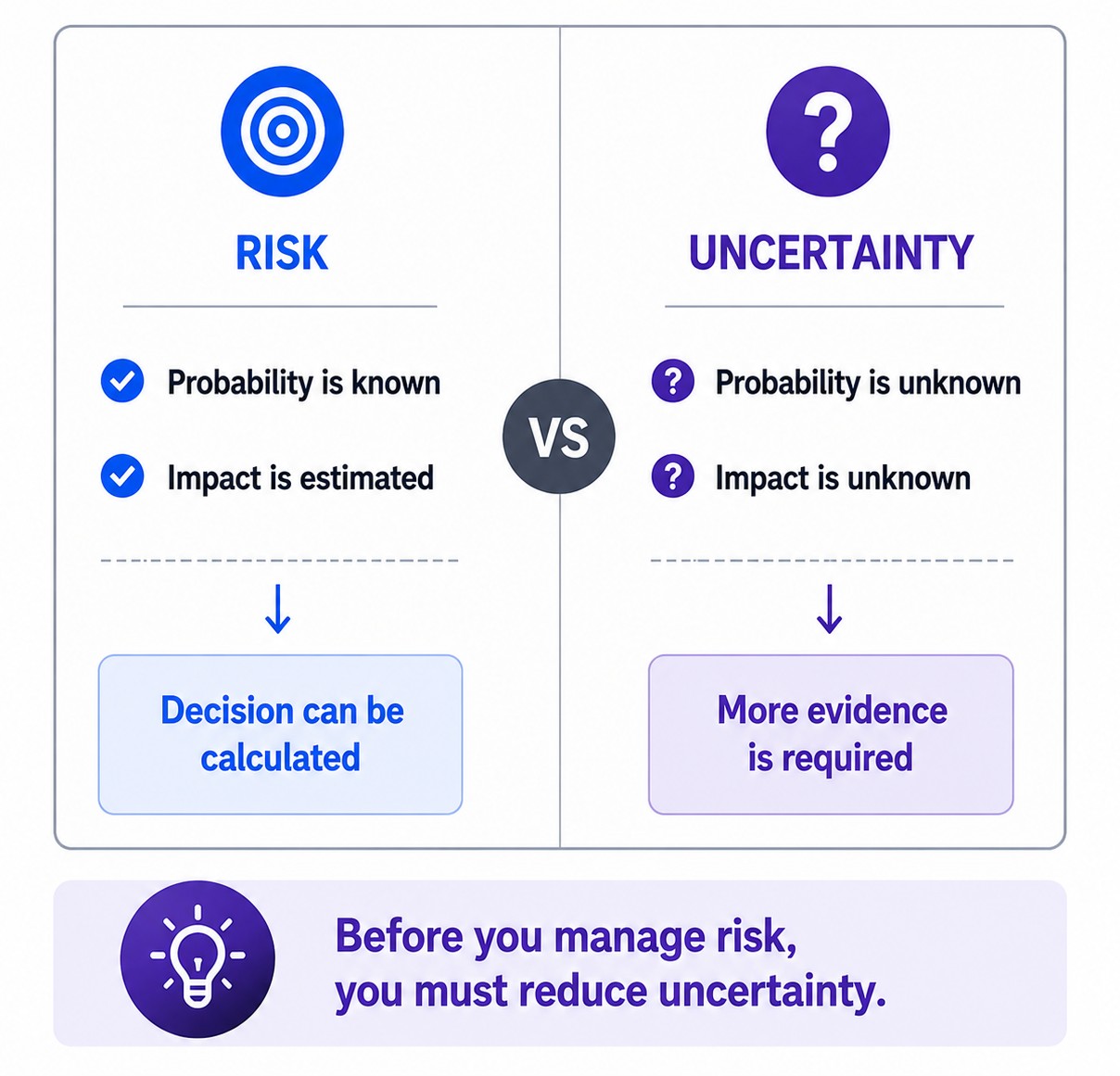
Risk is usually expressed as a combination of probability and impact.
Risk-based vulnerability management prioritizes remediation according to the likelihood of exploitation and the potential business impact of compromise. Both dimensions depend on reliable evidence.
When exploitability, exposure, technical impact, or business context are unknown, risk cannot be estimated with confidence. Teams are therefore managing uncertainty rather than measurable risk.
Risk management begins only after enough uncertainty has been removed to support a credible judgment.
Risk-Based Vulnerability Management begins only after sufficient uncertainty has been removed through continuous vulnerability contextualization. Until exploitability, exposure, technical impact, and business context are understood, organizations are managing uncertainty rather than measurable risk.
Contextualizing vulnerabilities is important
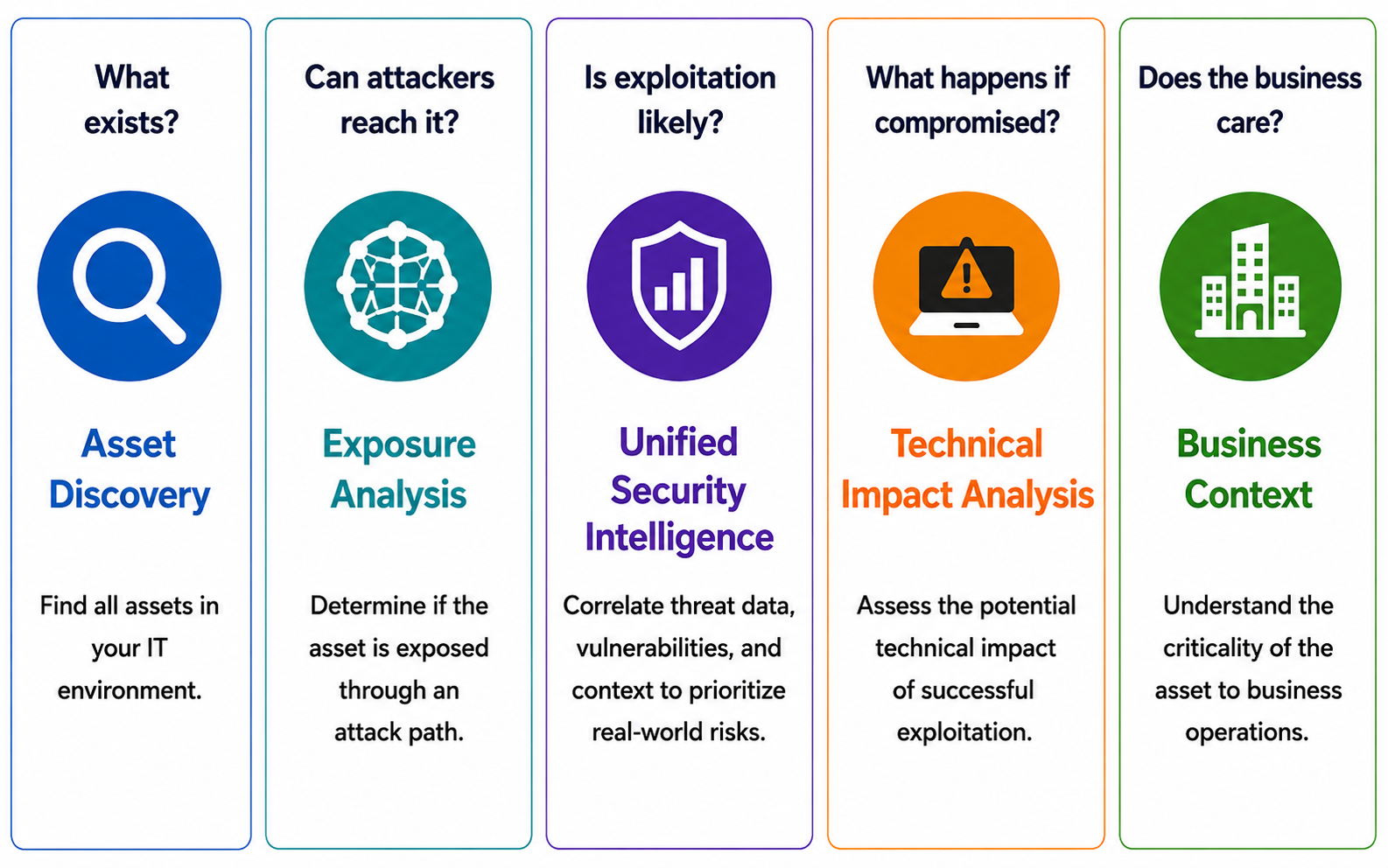
Risk-based vulnerability management is fundamentally a vulnerability contextualization process. Mature security programs progressively reduce uncertainty before estimating risk or prioritizing remediation.
Asset discovery shows the assets exist.
Exposure analysis determines what attackers can reach. Threat intelligence clarifies which vulnerabilities are being exploited.
Unified security intelligence covering thousands of vulnerabilities, misconfigurations, remediation data, compliance controls, posture configurations, attack techniques and insights.
Technical impact analysis to Understand how exploitation could affect systems, services, and operations.
Every stage is enabling to prioritize millions of vulnerabilities for Risk-Based Vulnerability Management and preparing every vulnerability for Continuous Exposure Remediation.
Why security teams find it difficult to manage vulnerabilities
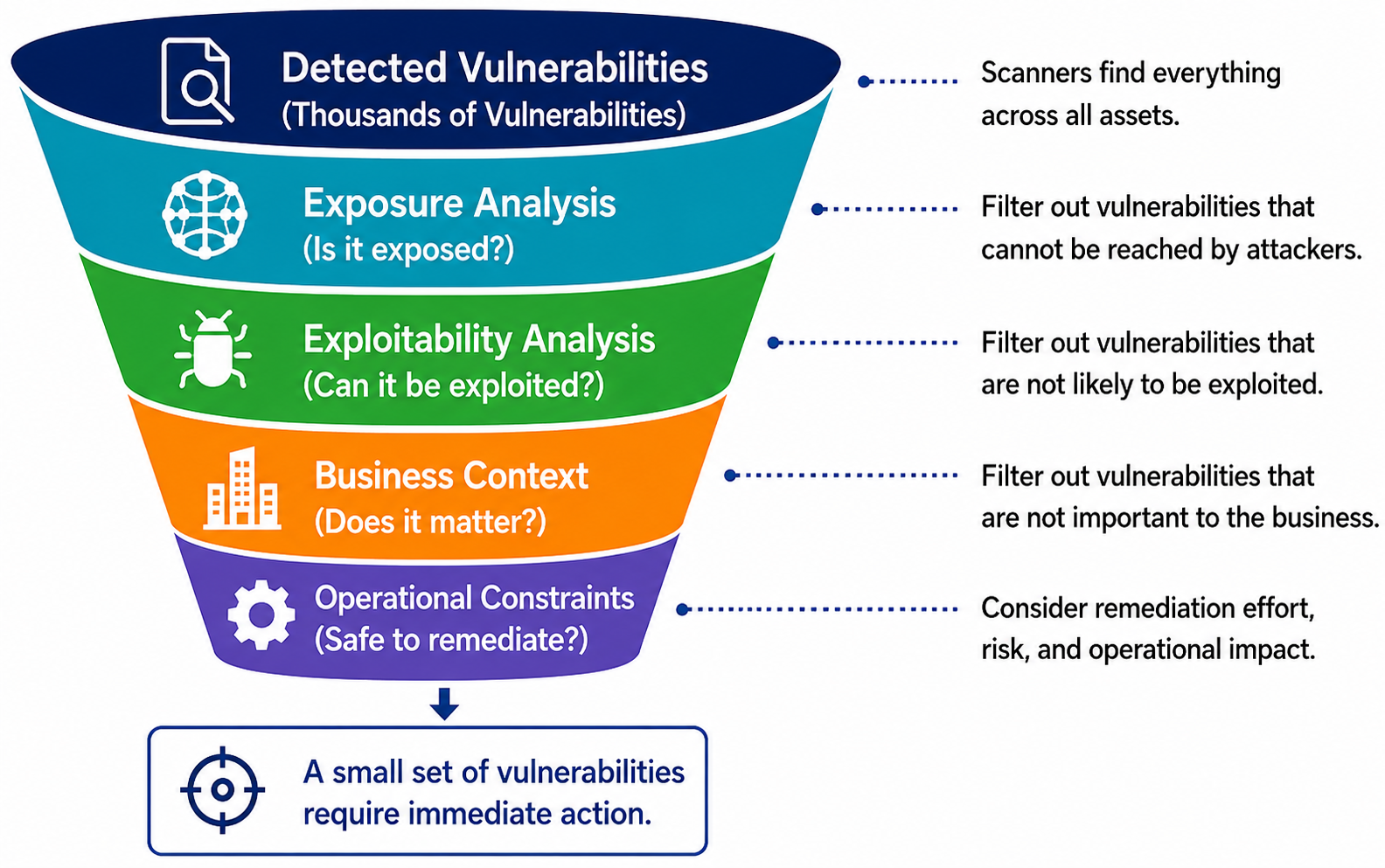
The largest volume in any vulnerability management program exists at the point of detection, where scanners detect vulnerabilities across assets, applications, and cloud environments.
Only a small fraction of these vulnerabilities results in immediate remediation.
Before remediation, security teams must determine whether vulnerability is exploitable through an attack path, whether exploit code exists or active exploitation is occurring, whether existing security controls reduce the likelihood of compromise, how critical the affected asset is to the business, and what operational impact remediation may introduce.
Each layer of analysis removes uncertainty and filters out findings that do not require immediate attention.
The primary bottleneck is therefore not vulnerability discovery. It is continuously contextualizing vulnerabilities to support
Risk-Based Vulnerability Management. Only after vulnerabilities have been prioritized according to current risk can Continuous Exposure Remediation begin.
Why CVSS Does Not Tell You What to Do
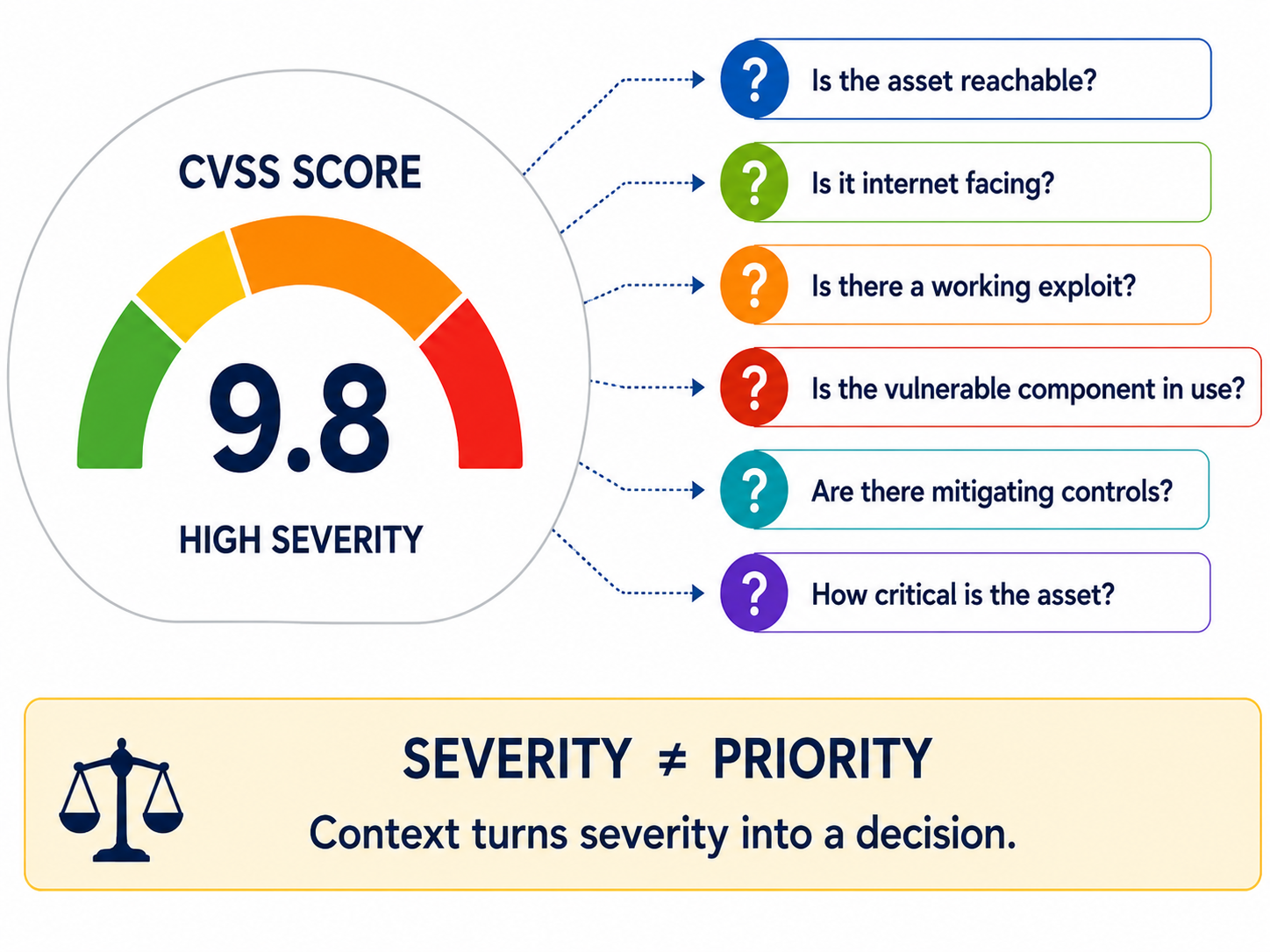
A CVSS score describes the potential technical severity of a vulnerability under standardized conditions.
It does not tell a team whether the affected asset is reachable, whether a working exploit exists, whether the vulnerable component is in use, whether compensating controls are present, or whether the system is important to the business.
A high score can therefore remain a low-priority action, while a lower score may demand immediate remediation.
Context transforms severity into a risk-based remediation decision. Without context, severity remains a technical measurement rather than a reliable indicator of remediation priority.
How mature security teams think
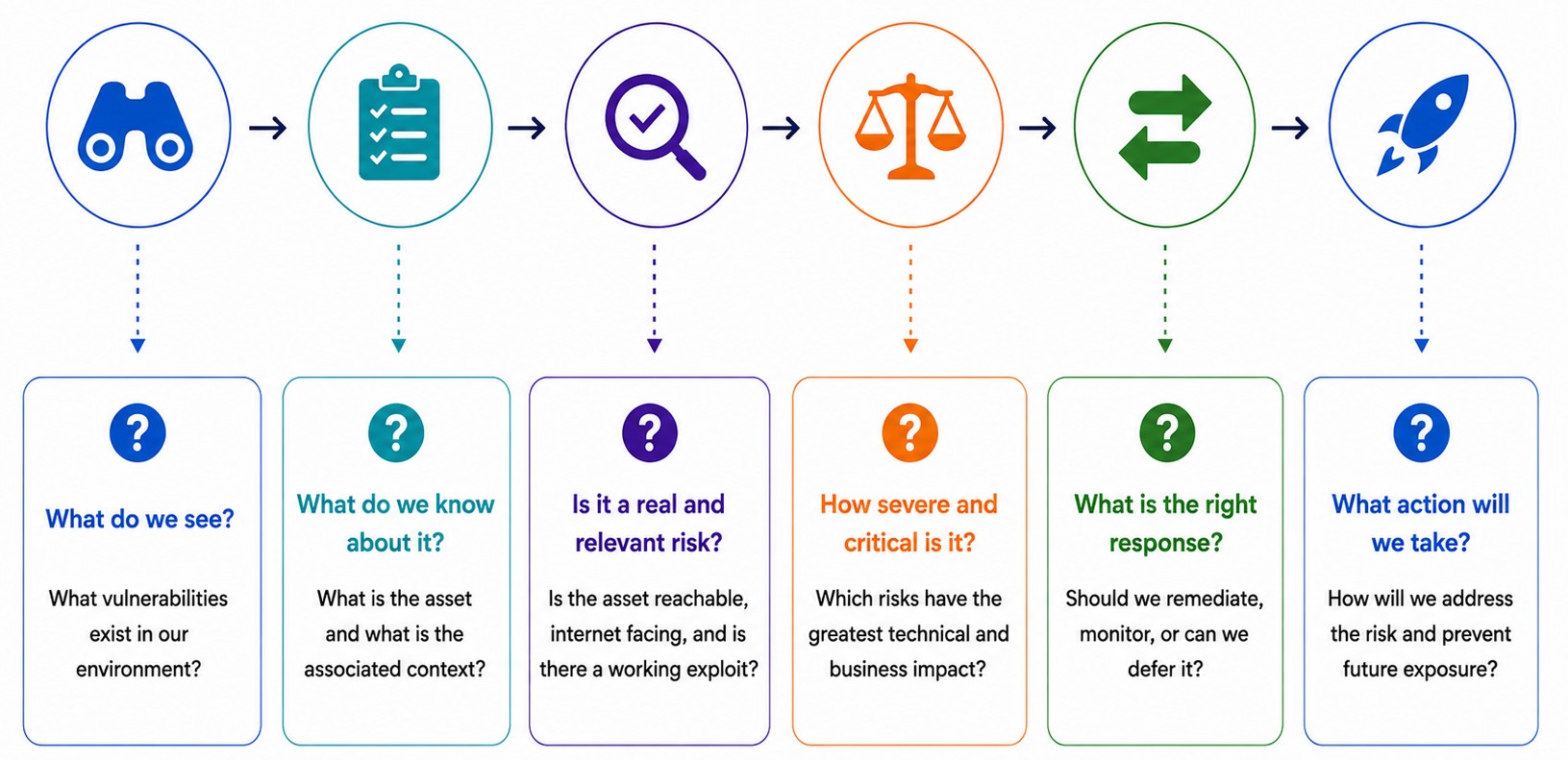
Mature security teams continuously re-evaluate vulnerabilities as new evidence becomes available. This continuous enrichment enables Risk-Based Vulnerability Management to adapt to changing environments and ensures remediation priorities remain aligned with the current threat landscape.
Rather than prioritizing vulnerabilities solely by severity, they continuously validate exposure, exploitability, technical impact, and business context until enough uncertainty has been removed to estimate risk with confidence.
Every finding progresses through a series of questions:
• Does the vulnerability exist on an active asset?
• Is the asset exposed?
• Is exploitation likely?
• What technical impact could exploitation have?
• How important is the affected system?
• Can remediation be performed safely?
Each answer removes uncertainty and increases confidence until a remediation decision can be made.
The SecPod Perspective
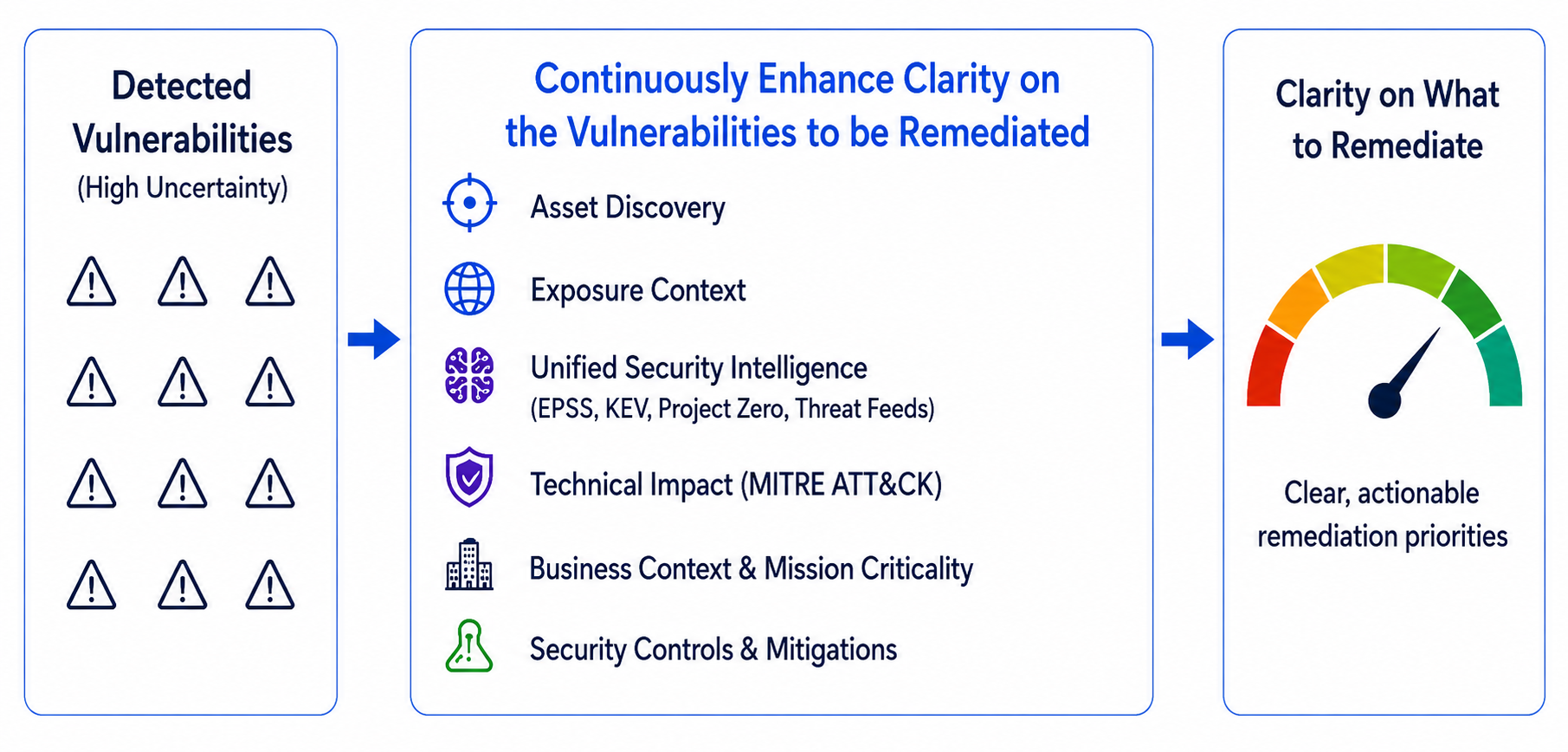
SecPod’ saner continuously enriches every vulnerability with technical, threat, environmental, and business context to reduce uncertainty throughout the vulnerability lifecycle.
This enables Risk-Based Vulnerability Management by continuously identifying the exposures that present the greatest operational risk.
The resulting remediation guidance drives Continuous Exposure Remediation, ensuring organizations continuously patch vulnerabilities, fix misconfigurations, apply mitigating controls, or monitor lower-priority exposures as conditions evolve.
Continuous uncertainty requires continuous exposure remediation
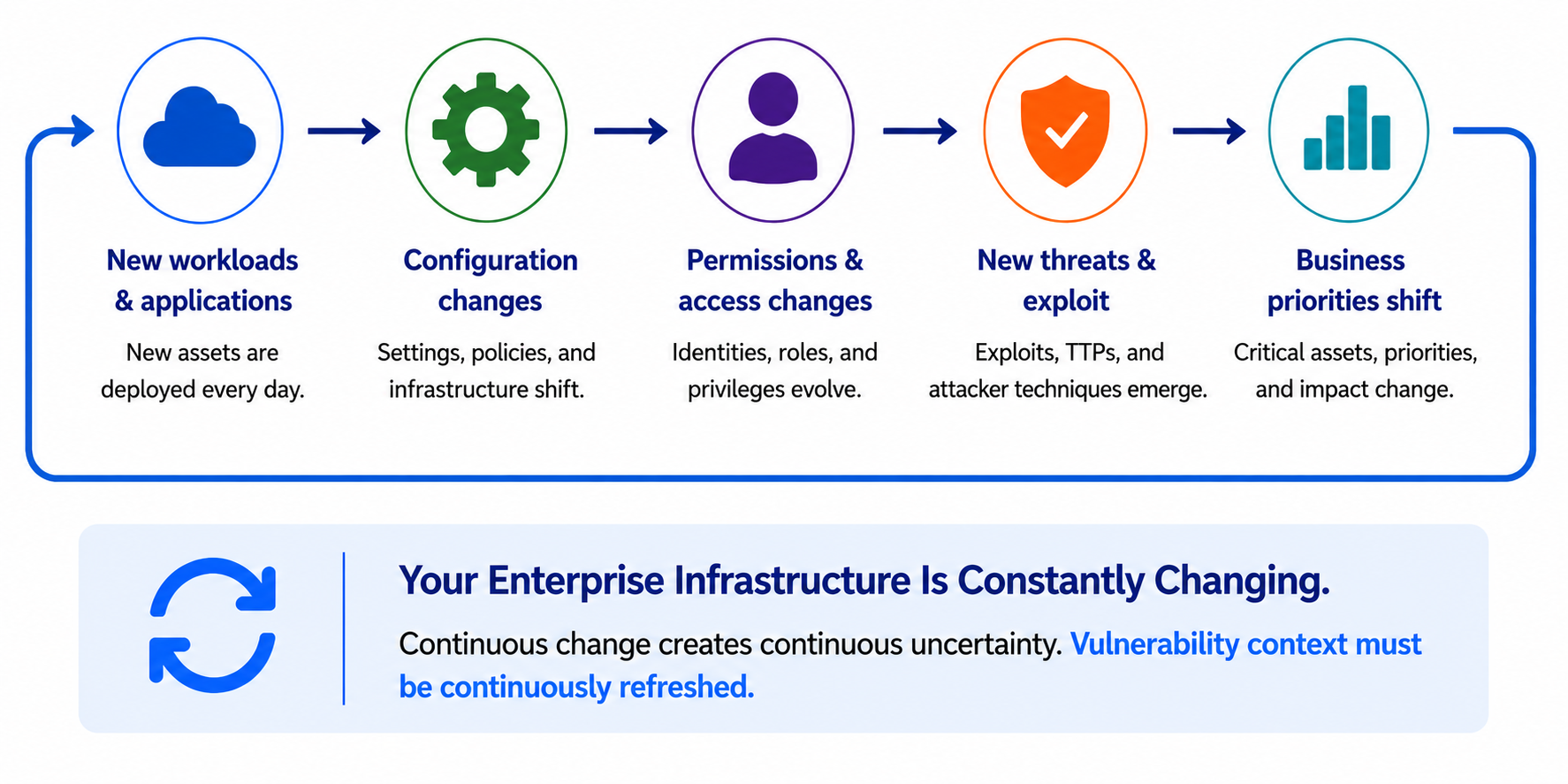
Continuous uncertainty requires continuous contextualizing vulnerabilities to enable Risk-Based Vulnerability Management.
Risk-Based Vulnerability Management drives Continuous Exposure Remediation. Together, they ensure organizations continuously respond to the exposures that matter most rather than relying on periodic vulnerability assessments.
Know more about Saner
Discover how Saner can reduce uncertainty with its capabilities in continuous vulnerability prioritization and remediation


