


Enterprise guide to cyberattack prevention
How large enterprises can reduce attack surface across endpoints, networks, and cloud environments
Cyberattack usually starts with a security weakness that is not remediated.
This can be an exposed endpoint, unpatched server, misconfigured cloud resource, an old identity, disabled security control, vulnerable cloud workload, risky open port, or an unmanaged asset.
Each one may look isolated, but together they create the attack paths attackers use to breach their target.
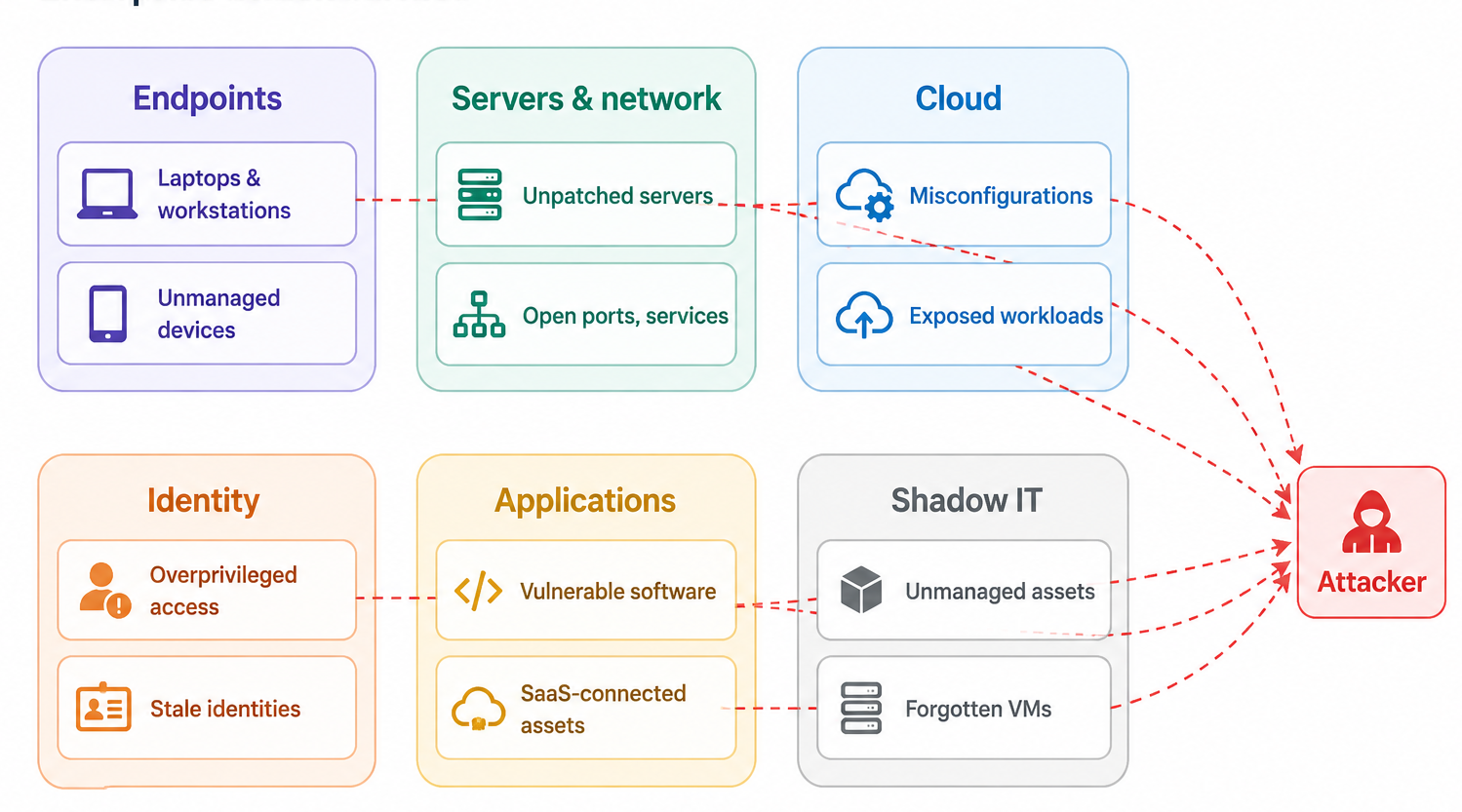
Attackers do not need the entire environment to breach. They only need one exploitable weakness that remains open long to exploit.
Proactive cyberattack prevention is the discipline of detecting, normalizing, prioritizing, remediating, validating, and governing those weaknesses before attackers can use them.
It shifts security from detecting attacks in progress to reducing the conditions that make attacks possible.
For enterprises, this matters because the attack surface is no longer limited to endpoints. It spans laptops, servers, network devices, cloud workloads, identities, cloud storage, virtual machines, containers, applications, SaaS-connected assets, and hybrid infrastructure.
A fragmented security model cannot manage this attack surface at speed and scale.
SecPod Saner platform is built for this prevention-first approach.
It connects endpoint, servers, network and cloud. The purpose is to reduce attack surface, eliminate exploitable weaknesses, and verify that risk has been reduced across IT infrastructure.
What is proactive cyberattack prevention?
Proactive cyberattack prevention is a security approach that focuses on removing exploitable weaknesses before they become attack entry points.
It is not the same as detection.
Detection identifies suspicious or malicious activity after something begins. Prevention reduces the probability of an attack success.
It is also not limited to patching.
Patching is one prevention control, but attackers exploit more than CVEs. They exploit non-CVEs such as misconfigurations, exposed assets, weak controls, posture anomalies, overprivileged access, missing updates, and risky services.
A proactive cyberattack prevention program must answer five questions:
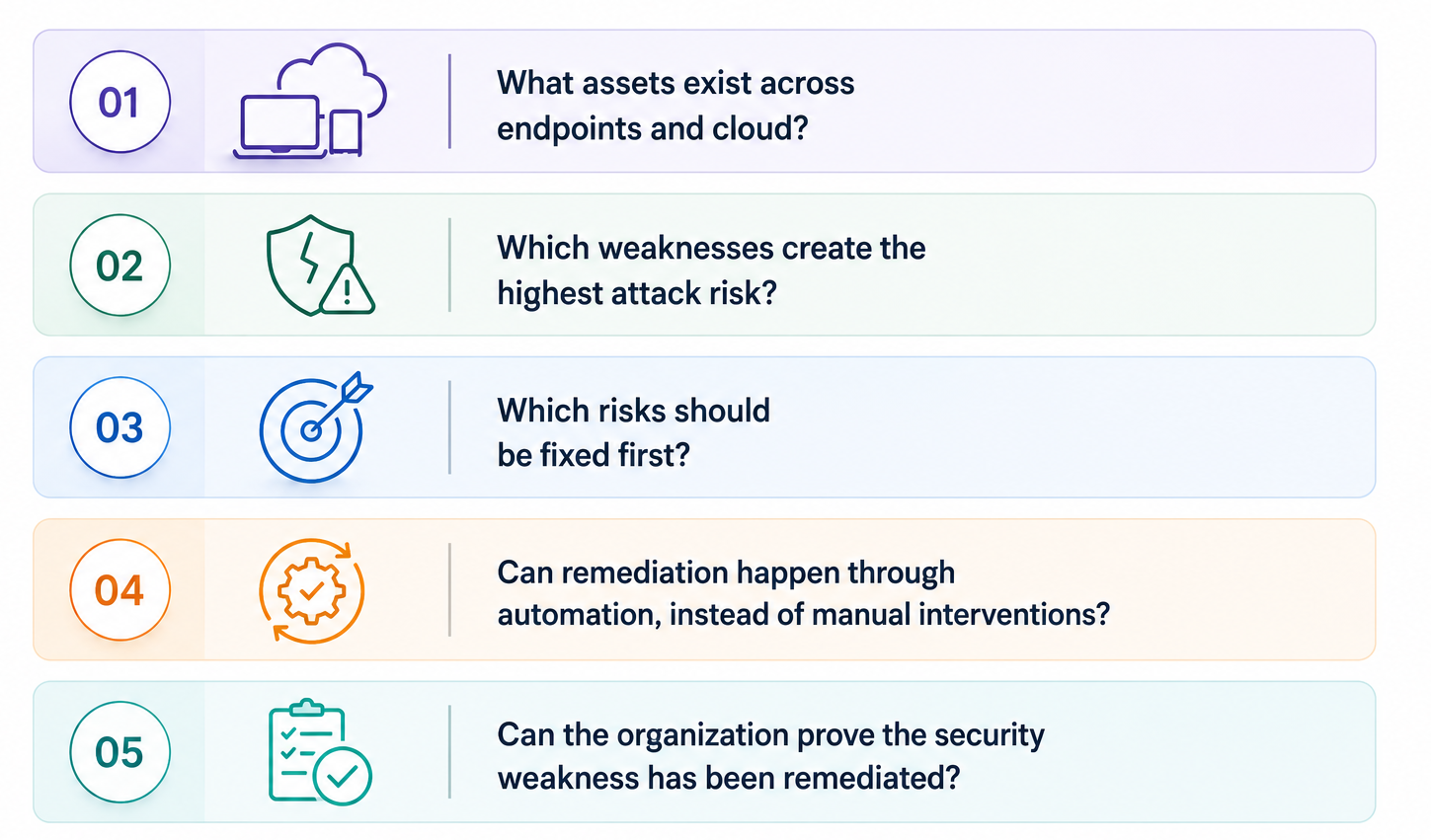
Most enterprises struggle because each answer needs a different tool.
Asset inventory, vulnerability data, cloud posture, patch management, and compliance.
Remediation depends on tickets and team coordination. This creates delay. Delay creates exposure. Exposure creates attack opportunities.
Four problems expanding the attack surface
Asset visibility is incomplete
Security teams cannot prevent attacks against assets they cannot see.
Unknown endpoints, unmanaged servers, temporary cloud resources, inactive systems, forgotten virtual machines, and shadow IT create unmanaged exposure.
Asset discovery must cover endpoints, servers, cloud workloads, and network assets continuously.
Periodic scans are not enough because enterprise environments change daily.
Vulnerability volume exceeds remediation capacity
Enterprises do not fail because they lack vulnerability findings. They fail because findings outnumber remediation capacity.
Every scan adds more issues. Every cloud account adds more posture gaps. Every business unit adds more cloud and endpoint assets. Every endpoint adds software risk.
Cloud exposure changes faster than manual governance
Cloud environments change quickly. New resources appear. Security groups change. Permissions expand. Storage becomes exposed. Workloads drift from baselines.
Misconfigurations create attack paths that traditional endpoint-only tools cannot see.
Remediation is split across teams
Security teams detect. IT teams’ patch. Cloud teams configure. Infrastructure teams approve. Compliance teams report. Leadership asks for proof.
Each manual intervention adds delay. Attackers do not wait for internal coordination.
Attack surface management using Saner
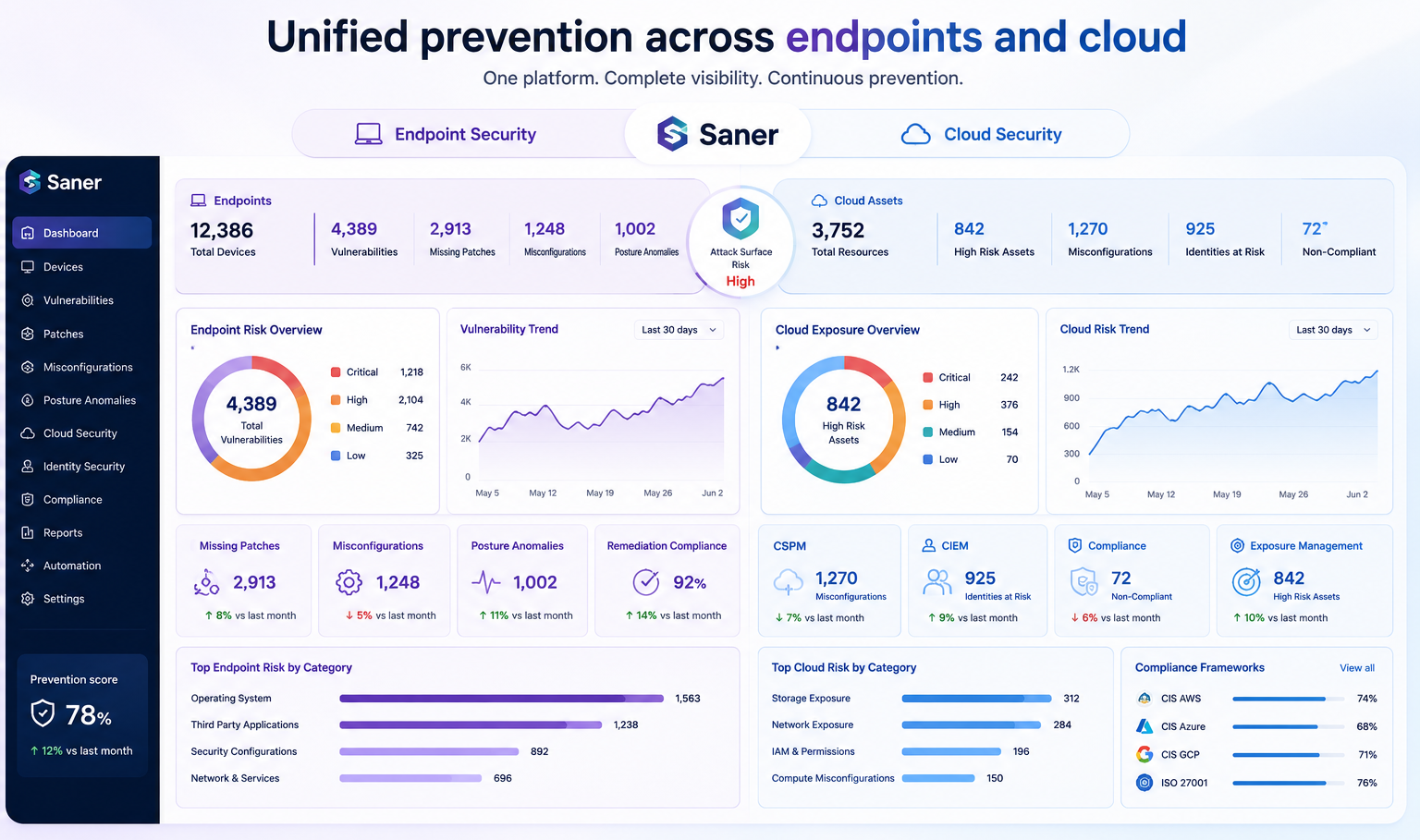
Saner turns attack surface management into a continuous prevention workflow.
It gives security and IT teams ongoing asset visibility and normalization so they can see what exists, where it runs, who owns it, and how each asset contributes to exposure risk.
By continuously discovers and maps internal and external assets, identifying vulnerabilities, misconfigurations, and exposure paths before they can be exploited.
Saner can correlate asset context, ownership, and risk intelligence to prioritize the exposures most likely to increase attack risk.
It prioritizes vulnerabilities and exposures based on risk context rather than severity scores alone, helping teams focus on the issues that can change attack outcomes.
Saner automates remediation workflows with guided actions, patch deployment, and policy enforcement to eliminate exposures quickly and consistently.
Continuous validation confirms fixes are effective, ensuring attack surface reduction is measurable and sustained.
Detection, normalization, prioritization, remediation, and validation work in one platform ensuring reduction in manual delays and making proactive attack surface reduction possible.
Saner platform and the weakness-first approach
Most cybersecurity programs are built around threats. Threat intelligence, threat detection, threat response, threat hunting, and incident response all matter.
They answer a necessary question: what is attacking us?
Proactive prevention starts earlier. It asks: what weaknesses exist, how exposed are they, and how quickly can they be eliminated?
This weakness-first approach is more useful for enterprise risk reduction because every attack depends on an exploitable weakness.
The weakness may be a known CVE, cloud misconfiguration, an exposed service, a missing patch, a risky identity permission, changes in control settings, security deviations, outliers or an unmanaged endpoint.
A security program that only tracks vulnerabilities sees only part of the problem and leaves other exposure paths unmanaged.
Saner Platform is built around a weakness-first approach to cyberattack prevention.
Instead of waiting for attacks to begin, Saner can identify and remediate the weaknesses attackers depend on: known CVE, cloud misconfiguration, an exposed service, a missing patch, a risky identity permission, changes in control settings, security deviations, outliers or an unmanaged endpoint.
The result is a PREVENT operating model that reduces attack surface.
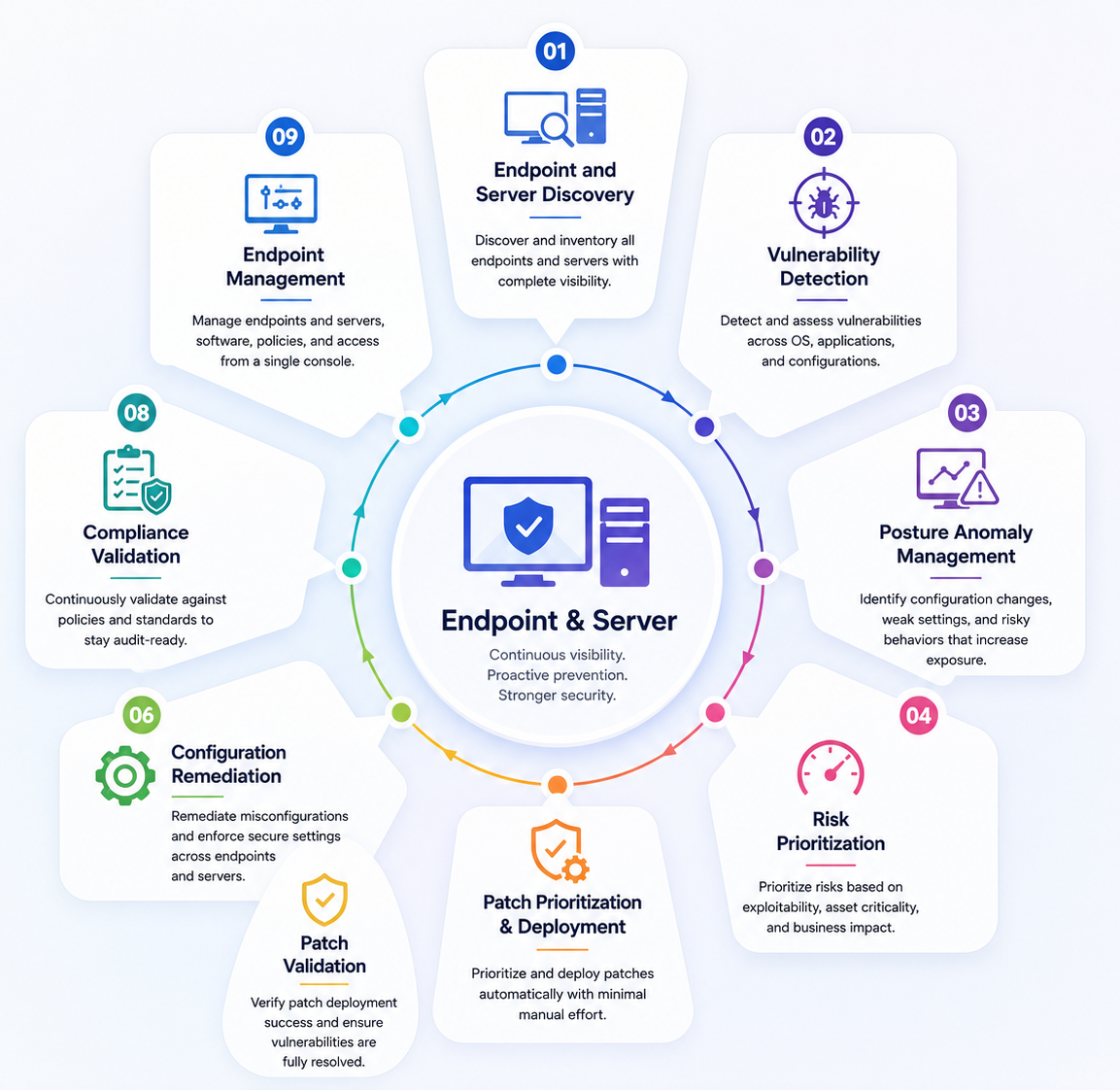
Proactive prevention across endpoints and servers
Endpoints and servers remain one of the most common attack entry points. They contain software & hardware vulnerabilities, missing patches, weak configurations, risky applications, local privilege escalation paths, exposed services, and security control setting changes.
Saner brings these capabilities into one workflow, reducing tool dependency and helping security and IT teams move from finding endpoint risk to remediating it.
For security leadership, the outcome is reduced endpoint attack surface.
For IT teams, the outcome is less manual effort. For auditors, the outcome is proof that controls are applied and risk has been reduced.
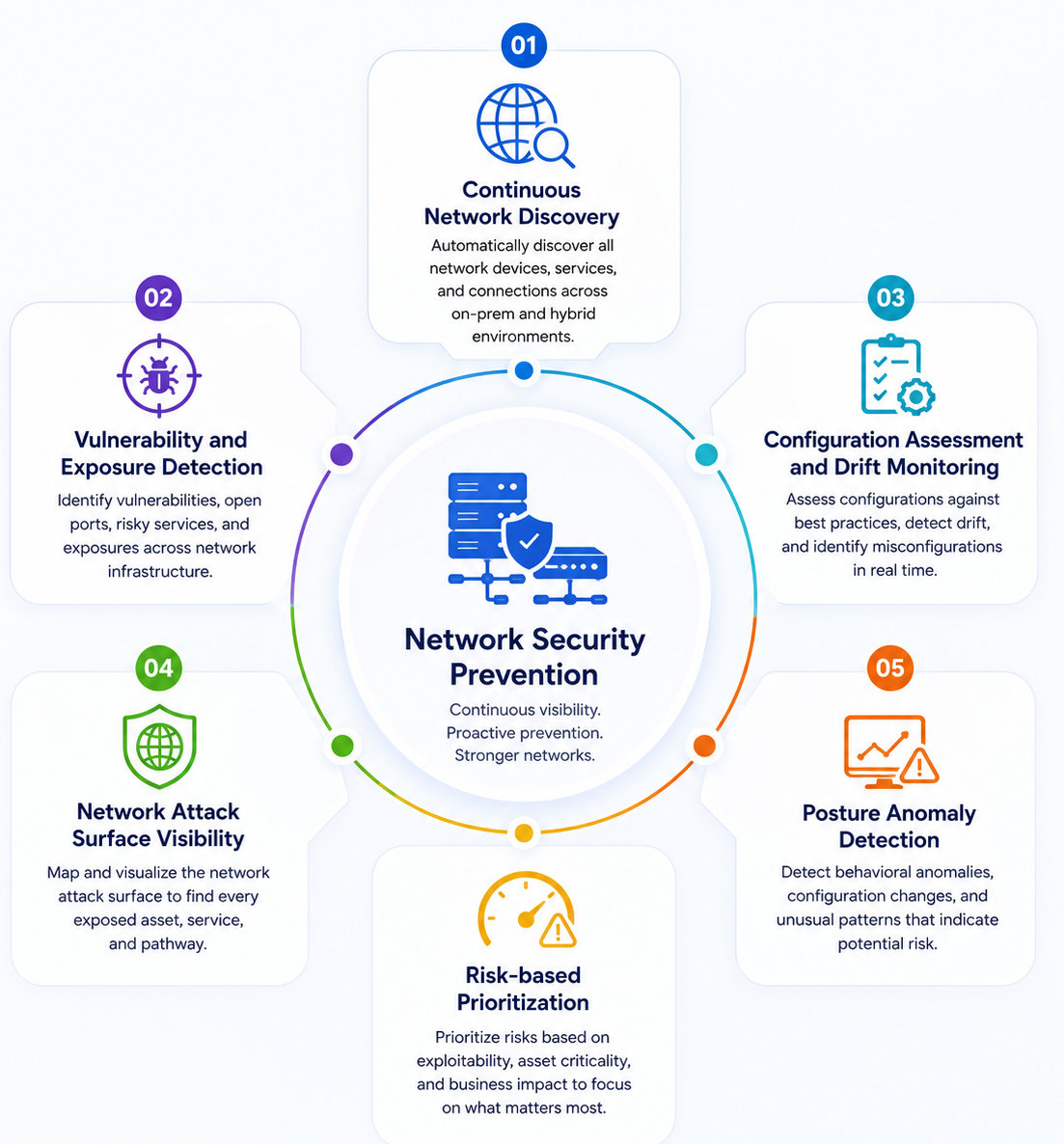
Proactive prevention across networks
Networks form the operational backbone of the enterprise and remain a primary target for attackers seeking initial access, lateral movement, privilege escalation, and persistence.
Weaknesses across these environments often include unpatched operating systems, vulnerable services, insecure protocols, misconfigured network devices, exposed management interfaces, weak segmentation, configuration drift, and unmanaged assets.
Saner continuously discovers servers, network devices, services, and communication paths to provide a complete view of infrastructure exposure.
It identifies vulnerabilities, misconfigurations, insecure services, and policy deviations, then prioritize them based on risk and business context.
Proactive prevention across cloud
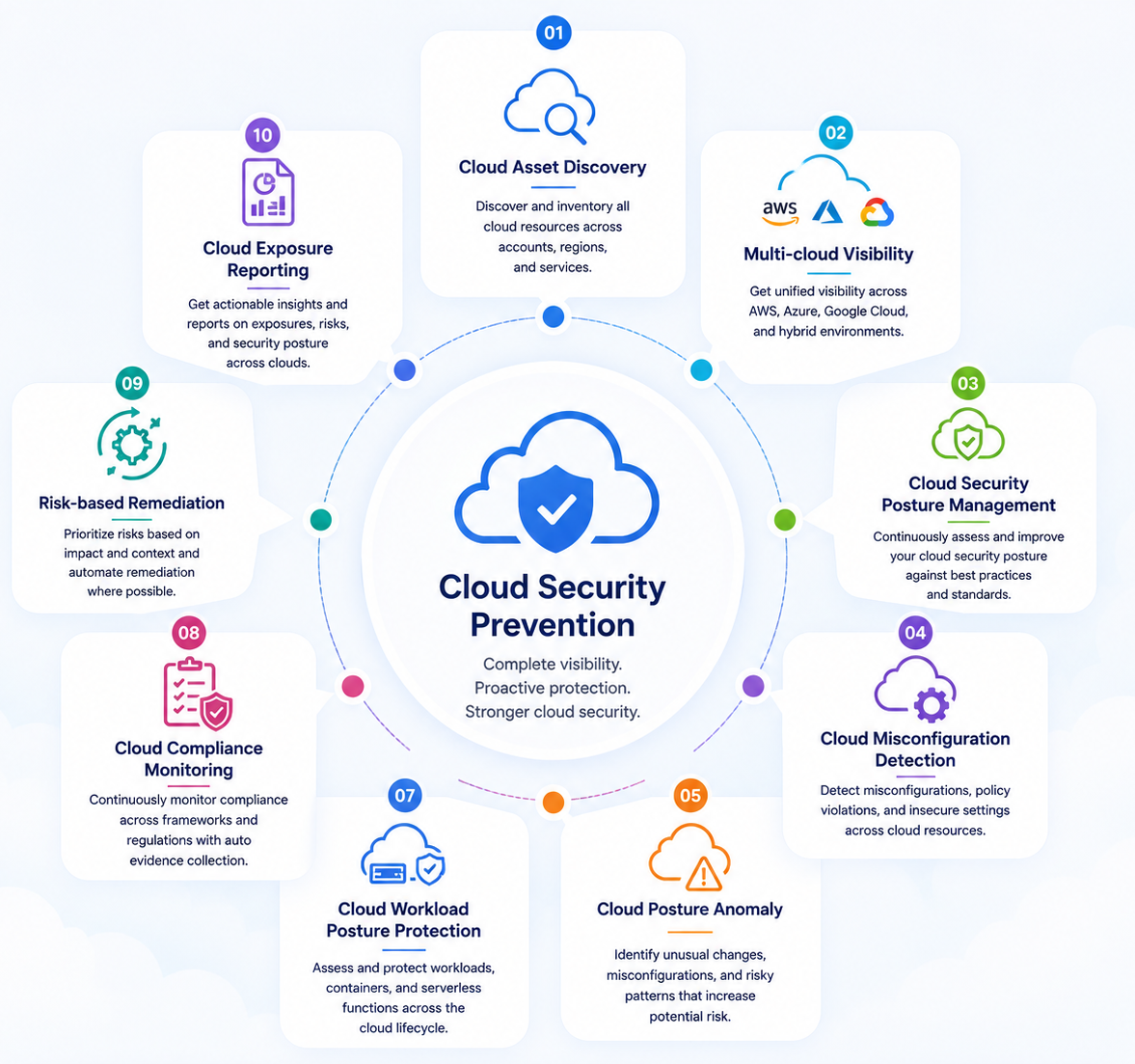
Cloud security requires more than cloud visibility.
Security teams need to know which cloud assets exist, how they are configured, how they are exposed, which workloads carry risk, and which misconfigurations require action.
Saner Cloud addresses cloud security from a prevention perspective.
It focuses on cloud exposure reduction, posture management, workload protection, compliance, risk assessment, and remediation.
Saner Cloud focuses on operational cloud risk such as cloud assets, workload exposure, posture gaps, misconfigurations, compliance drift, cloud identity and entitlement risks, and remediation.
Its role is to help enterprises secure the live cloud environments attackers can reach.
Saner as the foundation for proactive prevention
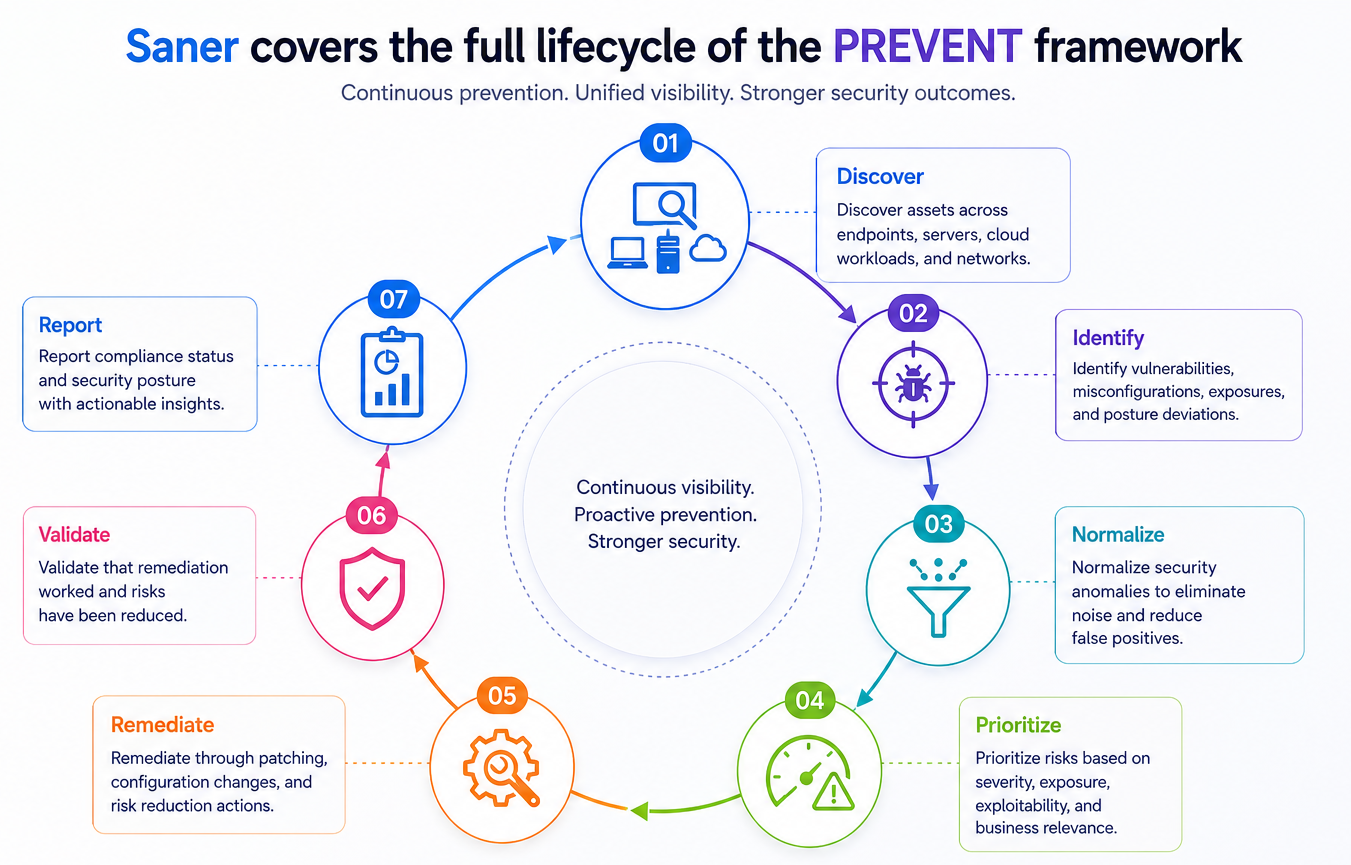
SecPod’s PREVENT framework is the foundation of proactive cyberattack prevention because it connects vulnerability risk with exposure context and remediation.
Saner covers the full lifecycle of the PREVENT framework. This lifecycle gives security and IT teams a shared operating model. It turns vulnerability management from a reporting function into a prevention function.
How Saner covers the attack chain
Attackers move through stages.
They discover exposed assets, gain access, establish persistence, escalate privileges, move laterally, access data, and evade detection. Proactive prevention works by breaking the chain before each stage becomes successful.
Saner can reduce risk across each stage.
Attack chain coverage
Reconnaissance: reduce what attackers can see
Attackers start by mapping reachable assets.
Exposed endpoints, open ports, unmanaged servers, internet-facing services, cloud resources, and shadow assets create discovery opportunities.
Saner helps reduce reconnaissance risk by providing asset visibility, endpoint discovery, cloud asset visibility, network asset inventory, exposure detection, and reporting.
Security teams can identify what is visible & unmanaged, and what must be removed, restricted, or remediated.
Initial access: close exploitable entry points
Initial access often comes from unpatched vulnerabilities, exposed services, weak configurations, vulnerable applications, or cloud misconfigurations.
Saner identifies vulnerabilities, cloud posture weaknesses and risky configurations.
Patch and endpoint management capabilities help remediate known issues. Risk prioritization helps teams act first on the issues attackers are most likely to use.
Persistence: detect and correct control drift
Persistence depends on changes that remain unnoticed.
Attackers may rely on unauthorized software, weak services, scheduled tasks, misconfigurations, exposed credentials, or altered controls.
Saner supports security posture management and anomaly detection to identify deviations from expected states.
It helps detect control drift, risky applications, unusual configurations, and posture gaps that can support persistence.
Privilege escalation: reduce exploitable weakness paths
Privilege escalation often depends on missing patches, weak configurations, excessive permissions, vulnerable services, and local system weaknesses.
Saner reduces privilege escalation risk by identifying vulnerable software, risky configurations, missing patches, and posture deviations.
Endpoint remediation and cloud risk remediation reduce the weak points attackers use to move from low privilege to higher control.
Lateral movement: reduce exposure across connected systems
Attackers move laterally when segmentation, identity permissions, endpoint posture, and service exposure allow movement between systems.
Saner helps by identifying exposed assets, vulnerable systems, misconfigurations, risky services, and cloud posture gaps across the environment.
Security teams can prioritize exposed systems and reduce pathways before attackers connect them into a broader compromise.
Ransomware attacks also depend on lateral movement and unresolved weaknesses.
Attackers use unpatched systems, weak controls, exposed assets, and poor segmentation to expand impact.
Saner reduces impact risk by helping teams remediate vulnerabilities, apply patches, enforce secure configurations, reduce exposure, and verify that fixes remain in place.
This lowers the probability that a single weakness becomes a business-wide outage.
What traditional security tools fall short
Visibility alone does not create prevention.
Vulnerability findings alone do not reduce risk. Runtime alerts alone do not close exposure.
The gap is execution: connecting discovery, prioritization, remediation, validation, and governance in one operating framework.
Saner’s advantage is the connection between finding risk and reducing it.
The platform perspective matters because attackers do not separate endpoint risk, cloud risk, exposure risk, and posture risk into separate categories. They combine whatever weakness gives them progress.
Why platform consolidation matters
Enterprise security teams already have too many tools. Adding another isolated scanner, patch tool, cloud posture tool, or reporting system can increase workload instead of reducing risk.
Proactive cyberattack prevention requires connected execution.
It needs one operating view across assets, vulnerabilities, exposures, posture, remediation, and validation.
Saner supports platform consolidation across endpoint security, cloud security, CVEM, patch management, compliance management, and security posture management. This helps reduce tool sprawl and gives teams one workflow for prevention.
Security operations must work across regions, business units, customer environments, and technology stacks.
A fragmented model becomes expensive and slow. A unified prevention platform creates operational control.
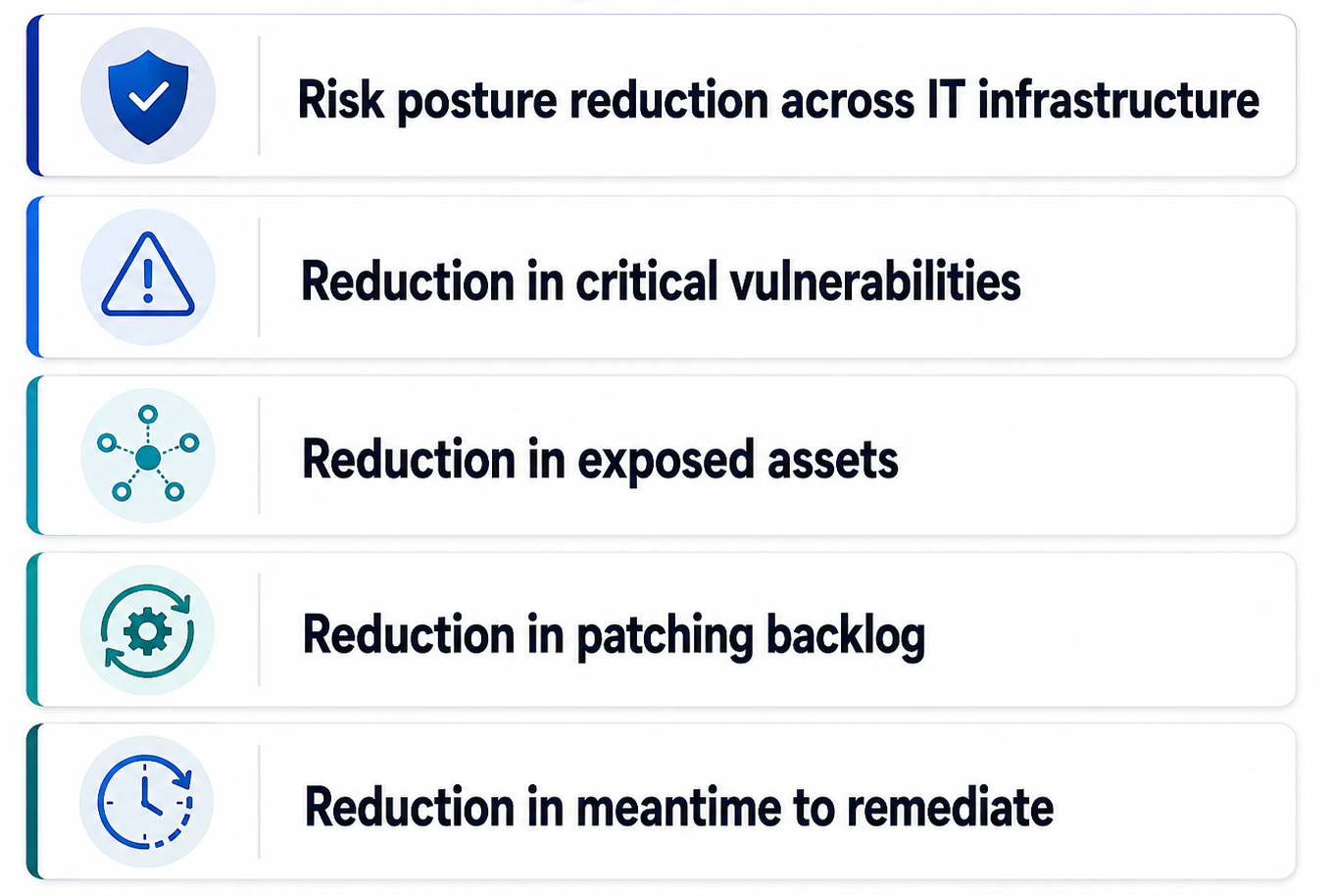
Cyberattack prevention metrics CISOs can track using Saner
By continuously identifying, prioritizing, and remediating exploitable weaknesses across the environment, Saner can reduce overall risk posture, remediate critical vulnerabilities, minimize exposed assets, reduce patching backlogs, and speed up mean time to remediate (MTTR).
Building a proactive cyberattack prevention program with Saner

This framework helps security teams move from siloed tool approach scattered findings to continuous risk reduction.
It starts with full visibility across assets, then expands detection beyond CVEs to include misconfigurations, exposures, and compliance gaps.
Next, it prioritizes what matters most based on real risk, not raw alert volume.
From there, teams can remediate through a single workflow and verify that fixes actually changed the live environment.
The final step is continuous governance, so deviations, recurrence, and new exposure do not rebuild the same risk.


