


A CCoE Guide to Cloud Security Risk Prioritization
Not every high-severity vulnerability deserves attention; it is the context that deserves. Saner cloud security risk prioritization looks at where a risk actually sits in your cloud environment to tell you what truly needs fixing now.
What is cloud risk prioritization
Cloud Security Risk Prioritization (CSRP) is the discipline of systematically ranking security weaknesses such as misconfigurations, vulnerabilities, identity risks, exposure paths, by their actual threat to your business, not just their raw technical severity score.
Traditional security tools score risks in isolation.
A CVSS 9.8 vulnerability on a development instance with no internet exposure is not the same as a CCSS 6.2 misconfiguration on a production database processing customer payment data.
CSRP, which uses the SSVC risk prioritization framework, provides a structure to analyze, classify, and manage risks at organization and account levels, based on a scoring criterion to help act on them based on their criticality and align them with MITRE ATT&CK security practices.
Here is the key difference. If CVSS/CCSS technical severity tells you how bad a security weakness is in theory. SSVC driven cloud risk prioritization tells you how bad it is in your cloud environment, for your business, right now.
Know more about risk prioritization in cybersecurity
Cloud security weaknesses pose a governance problem
The massive surge in cloud security weaknesses is not just a security team problem, it's a CCoE governance problem.
When teams are overwhelmed by unranked security weaknesses they develop workarounds: ignored dashboards, manually developed lists, and ad-hoc prioritization that varies by team. The result is inconsistent risk posture across your cloud environment.
A misconfigured S3 bucket in one client's AWS tenancy can produce audit results that flow across the portfolio. Without a structured prioritization system, there is no strong answer to the auditor's question: "How do you know which risks you fixed first, and why?"
What the CCoE can lose without cloud risk prioritization
Most cloud security tools such as CSPM, CNAPP, CWPP, CIEM generate security weakness notifications continuously.
Without a risk prioritization layer, each will create its own queue that no single team owns.
Platform engineers see container vulnerabilities. Cloud architects see landing zone misconfigurations. SOC teams see runtime notifications.
No one can see the complete risk picture, and no one knows which finding, if exploited, would cause the biggest business impact.
Risk prioritization is the layer that unifies these notifications into a single, ranked view the CCoE can act from.
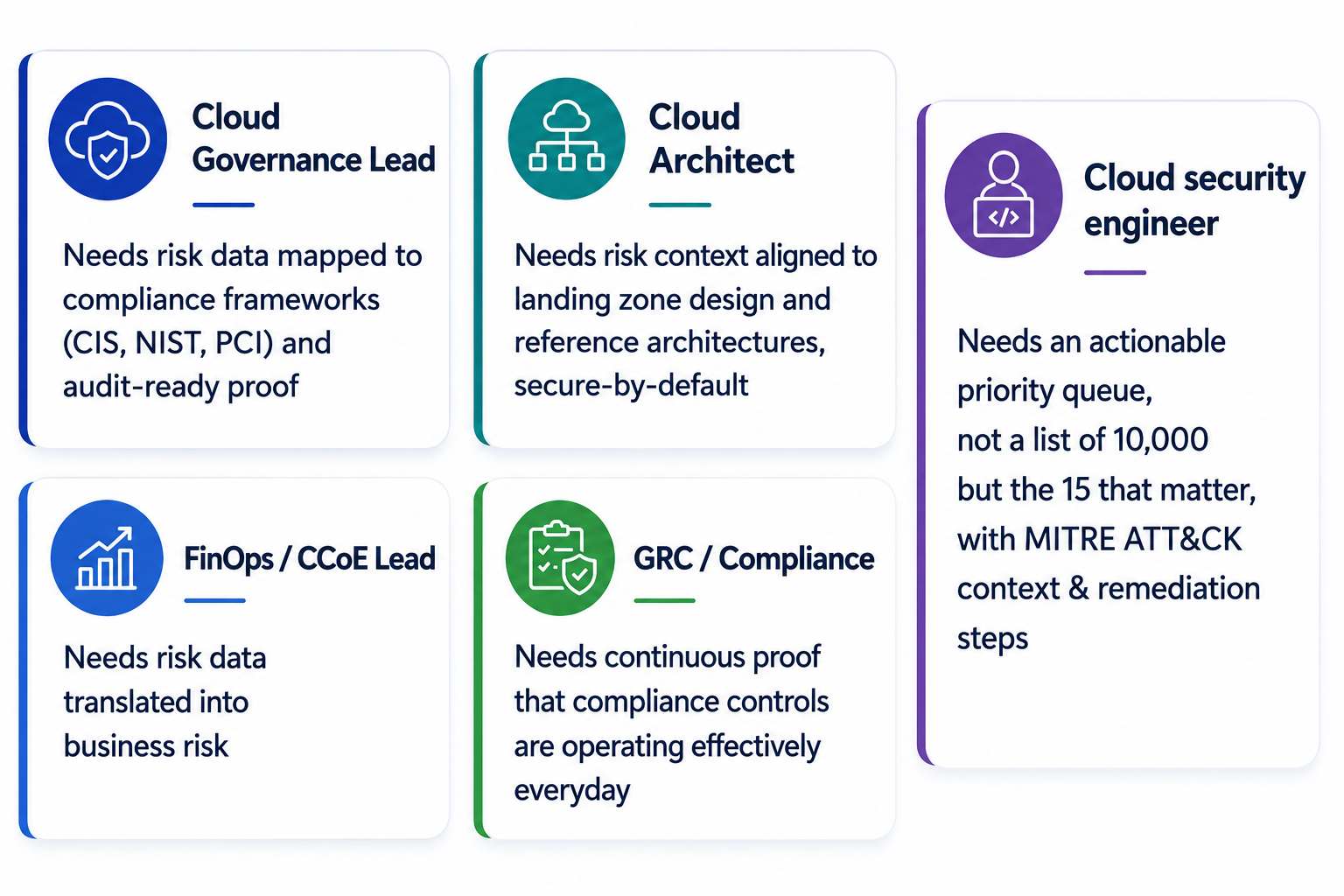
Who in the CCoE Needs Risk Prioritization
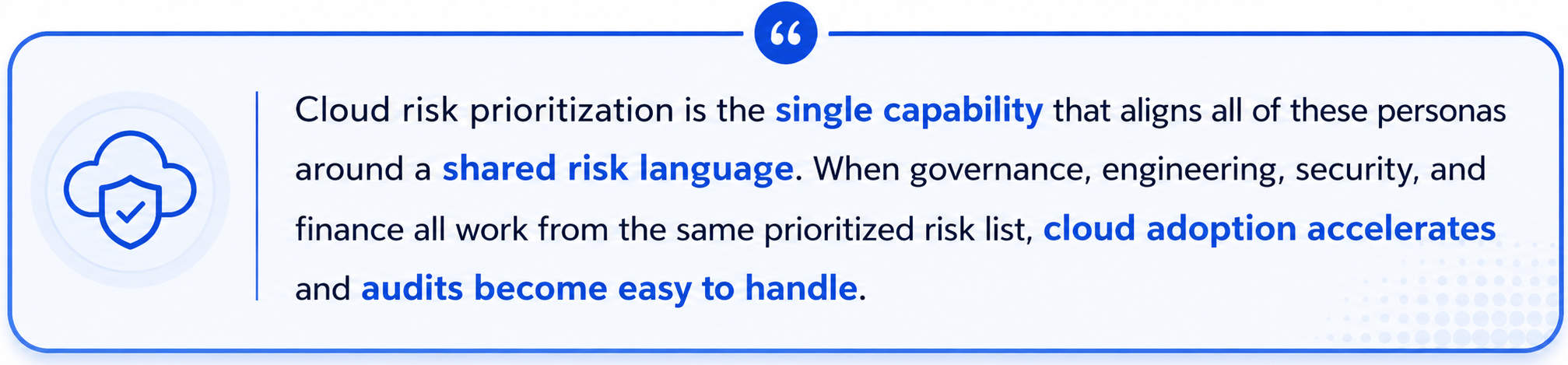
Cloud risk prioritization is not a task for one person. It maps to every major function within the Cloud Center of Excellence.
CISA SSVC risk prioritization framework
The foundation of any robust cloud risk prioritization program is a structured decision framework.
The industry standard adopted by CISA and must be embedded in cloud security risk prioritization is Stakeholder-Specific Vulnerability Categorization (SSVC) framework.
SSVC replaces single-score severity ratings with a decision tree that accounts for exploitation context, mission impact, and stakeholder role.
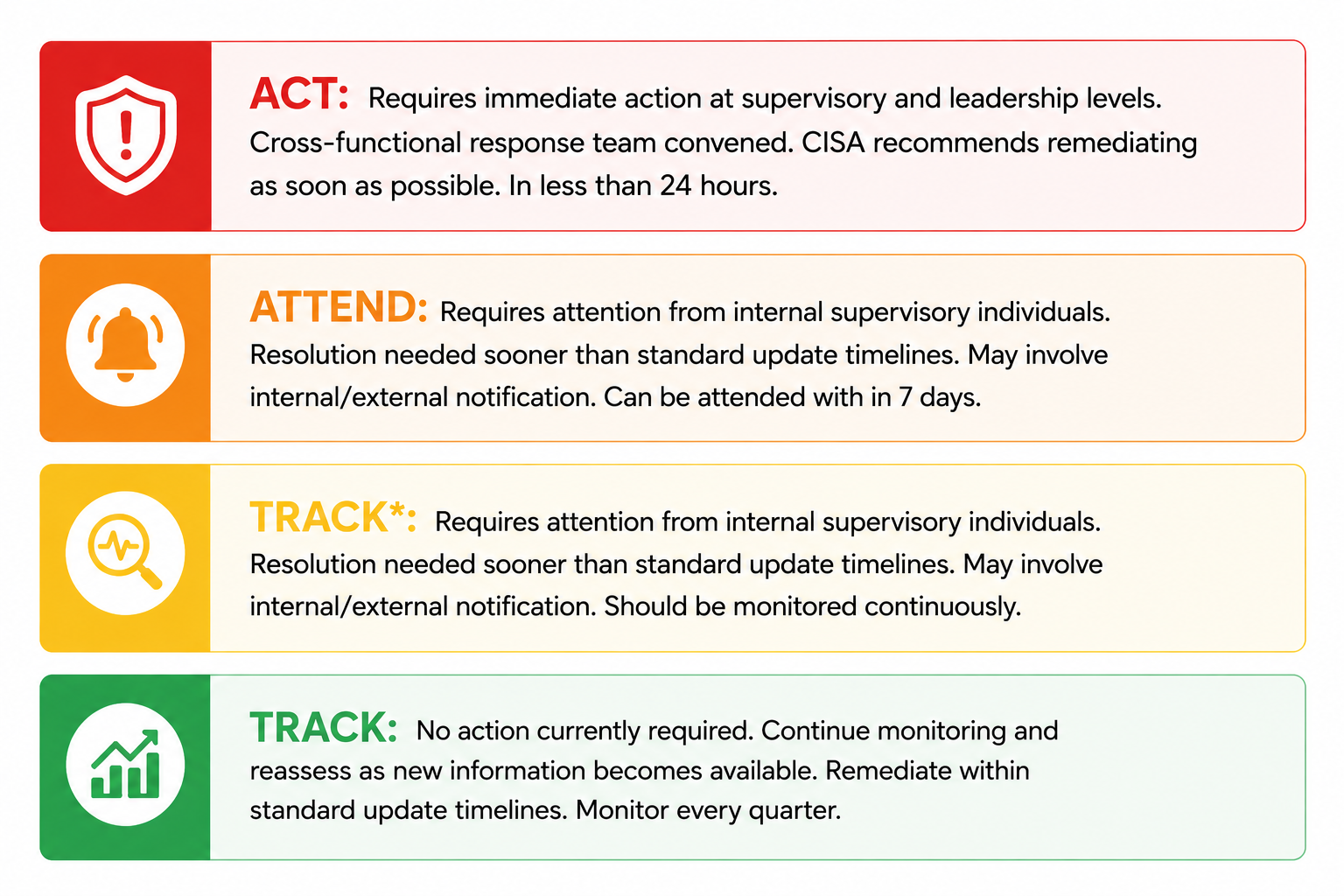
For cloud environments, SSVC provides the rationale that raw CVSS scores cannot. It classifies every risk into one of four action categories.
Know more about CISA SSVC risk prioritization
The SSVC model's power for CCoE teams is that it links the remediation decision to who needs to act, not just how bad the security weakness is.
Mission Prevalence: Not All Cloud Resources Are Equal
Decisions driven by SSVC framework in cloud environments are heavily influenced by the business criticality of the affected resource, what the framework calls Mission Prevalence.
Mission prevalence tagging is what makes risk prioritization meaningful at scale. It prevents CCoE from treating every finding identically regardless of what it's running on.
Every cloud resource CCoE governs should be classified into one of three tiers before risk scoring begins.
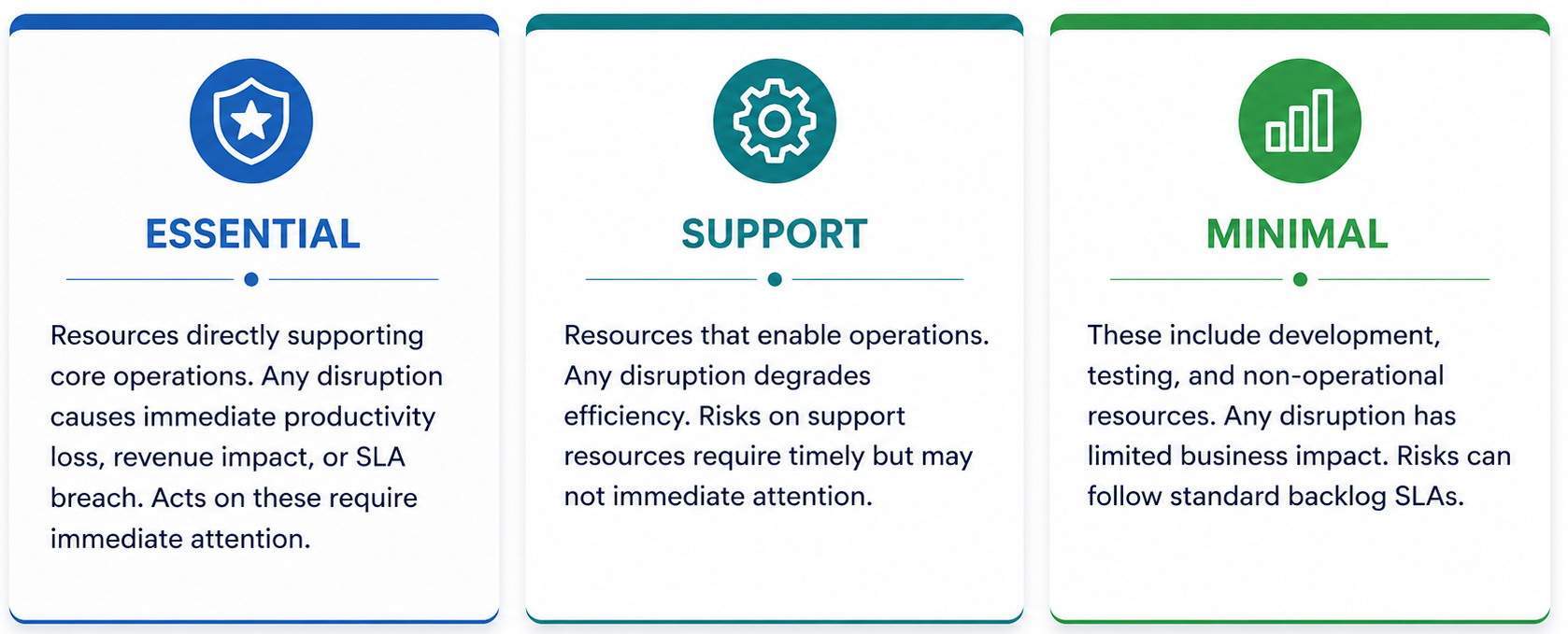
Resource Categories Within Mission Prevalence
Beyond the Essential/Support/Minimal tiers, each resource should also be tagged by its functional type to determine the nature of the risk if compromised. Here are the three.
- Business-centric resources are essential to daily operations. Any disruption to these can directly affect productivity and service continuity.
- Data-centric resources manage significant information processing and storage. Their risk profile is driven by data classification (PII, PHI, financial).
- Publicly accessible resources carry the highest network exposure and should always be prioritized for internet exposure.
How CISA Defines the Risk
The SSVC priority category (Act / Attend / Track* / Track) is not assigned manually; it is derived from a structured evaluation of four CISA-defined decision points.
These four dimensions, evaluated together, produce a composite risk score. Understanding them is essential for every CCoE team that wants to defend its prioritization decisions to auditors and leadership.
EXPLOITABLE
What is the current state of exploitation? Categorized as High, Medium, or Low based on whether active exploit code exists, how widely it is being used, and how easily an attacker can leverage the misconfiguration.
AUTOMATABLE
Can an attacker reliably automate exploitation steps 1 to 4 of the kill chain? Yes/No.
If Yes, the risk of large-scale, rapid compromise increases significantly and should elevate the SSVC category. Automation feasibility is assessed across reconnaissance, weaponization, delivery, and exploitation.
TECHNICAL IMPACT
If exploited, how much control does the adversary gain? Partial (limited control where attacker gains constrained access, e.g. denial-of-service) or Total (full control where attacker gains complete control over the affected infrastructure).
MISSION & WELLBEING
Does exploitation affect mission-critical resources (Essential / Support / Minimal) and does it create wellbeing risk for people who depend on those services? This is the business impact dimension that moves vulnerability into a governance priority.
Know more about how CISA SSVC evaluates vulnerabilities
Types of cloud security risks
Identity and Access Risk (CIEM)
The most exploited category in cloud breaches.
CIEM risk includes overly permissive roles, unused service accounts with high privilege, accounts with excessive permissions, and lack of MFA on privileged accounts.
In multi-cloud environments, identity risk is increased because each provider has its own CIEM model. Misconfigurations in one can cascade soon.
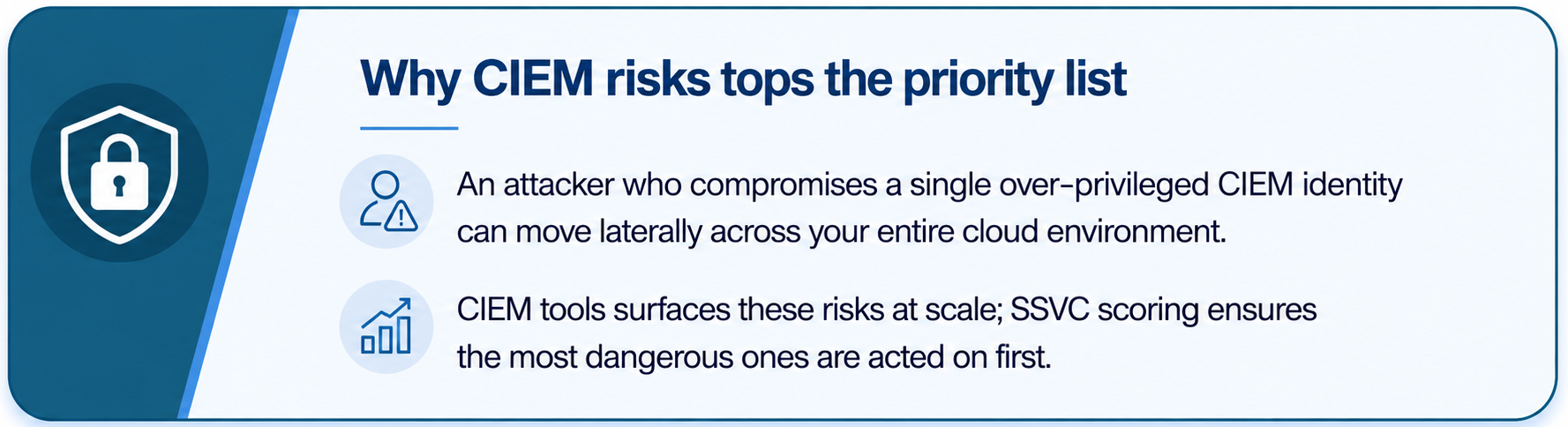
CIEM risks that are highly exploitable and automatable. They fall in the ACT category in the SSVC model because they directly enable lateral movement and privilege escalation.
Configuration and Posture Risk (CSPM)
Misconfiguration is the leading cause of cloud data breaches.
This category covers publicly exposed storage buckets, insecure default configurations on managed services, missing encryption, overly permissive security group rules, disabled logging and monitoring weaknesses.
CSPM tools automate detection, but without SSVC-based prioritization, they generate thousands of misconfigurations that conceal the critical ones.
A publicly accessible S3 bucket containing PII scores much higher on Mission & Wellbeing category than the same misconfiguration on an empty development bucket.
Workload and Container Risk (CWPP)
As organizations modernize towards containers and Kubernetes, workload protection becomes a distinct risk domain.
CWPP covers vulnerable container images in use, containers running as root, unpatched operating systems on cloud VMs, runtime anomalies indicating active exploitation, and Kubernetes RBAC misconfigurations.
The key risk factor for SSVC scoring is runtime exposure. A vulnerability in a running Essential workload that is exploitable and carries Total technical impact resolves to Act immediately.
Data and Compliance Risk
This category includes sensitive data without encryption, regulated data (PII, PHI, PCI) in unexpected locations, data exfiltration indicators, cross-border data transfer violations (GDPR, DPDP Act), and audit log gaps.
Data-centric resources carry the highest mission prevalence weighting because their compromise directly triggers regulatory penalties and customer trust loss exactly the outcomes that define Mission & Wellbeing category in the SSVC model.
Network and Exposure Risk
Network risk in cloud environments is fundamentally about what an external attacker can reach, and from what attack surface.
Internet-exposed services that should be internal-only, missing network segmentation, insecure API gateways, and direct internet routes to sensitive data stores all feed directly into the Exploitability decision point.
Network exposure is also a key input to automatable attack path analysis: if a misconfiguration is network-enumerable, the Automatable dimension often resolves to Yes, elevating the SSVC category.
MITRE ATT&CK Framework: Mapping security weakness to threats
Knowing that a misconfiguration exists is one thing.
Knowing which attacker tactic it enables and how they exploit it is what allows CCoE to prioritize with genuine threat intelligence rather than theoretical severity.
The MITRE ATT&CK framework bridges this gap by mapping every cloud risk to a specific tactic, technique, and recommended mitigation.
For each cloud risk, the MITRE ATT&CK mapping provides three layers of context that directly inform SSVC scoring:
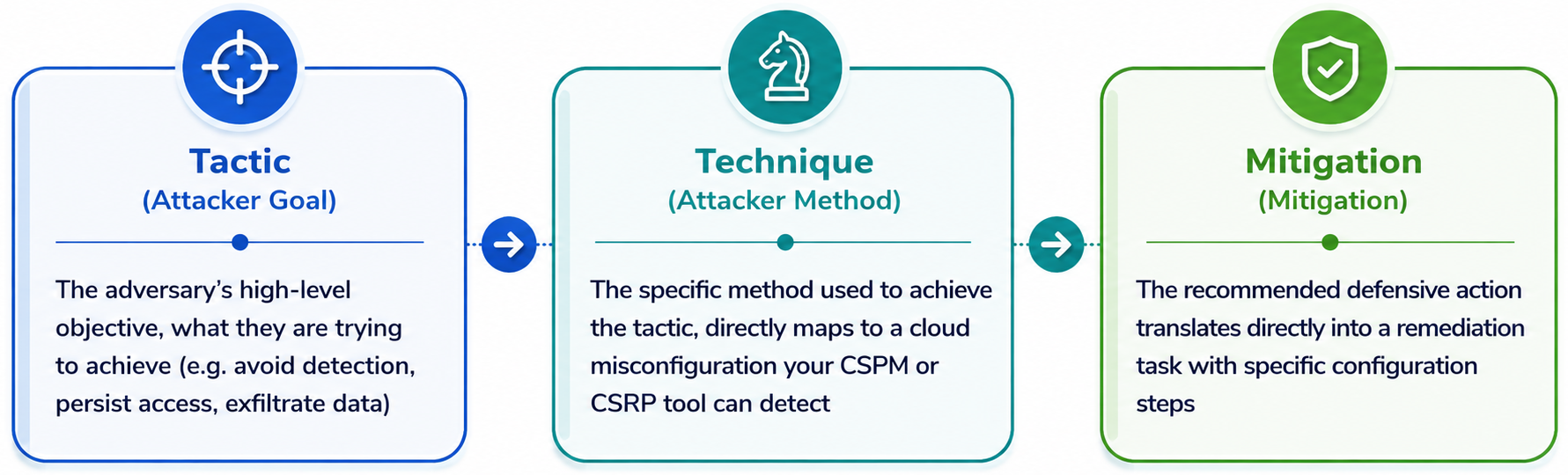
This three-layer mapping (Tactic – Technique – Mitigation) shows CCoE how a real adversary would exploit the misconfiguration, what their goal is, and exactly what to do to stop them.
Multiple tactics and techniques may map to a single risk, and multiple mitigations may apply This layered context is what makes ATT&CK mapping a genuine value addition for cloud risk prioritization.
Applying ATT&CK Context to SSVC Scoring
A misconfiguration that maps to a tactic in active use by known threat actors (e.g., TA0006 Credential Access, TA0009 Collection, TA0010 Exfiltration) should receive immediate attention in the Exploitable category.
If the mapped technique has active exploit code in the wild, the Automatable dimension resolves to Yes.
If the affected service is exposed to internet, the impact extends beyond the immediate resource.
Together, these MITRE ATT&CK-informed inputs directly moves a misconfiguration to higher SSVC category - from Track to Attend, or from Attend to Act.
KPIs that convert cloud risk into outcomes
The CCoE's risk prioritization program needs KPIs that translate directly into the language a CISO, CIO, and business unit leaders use.
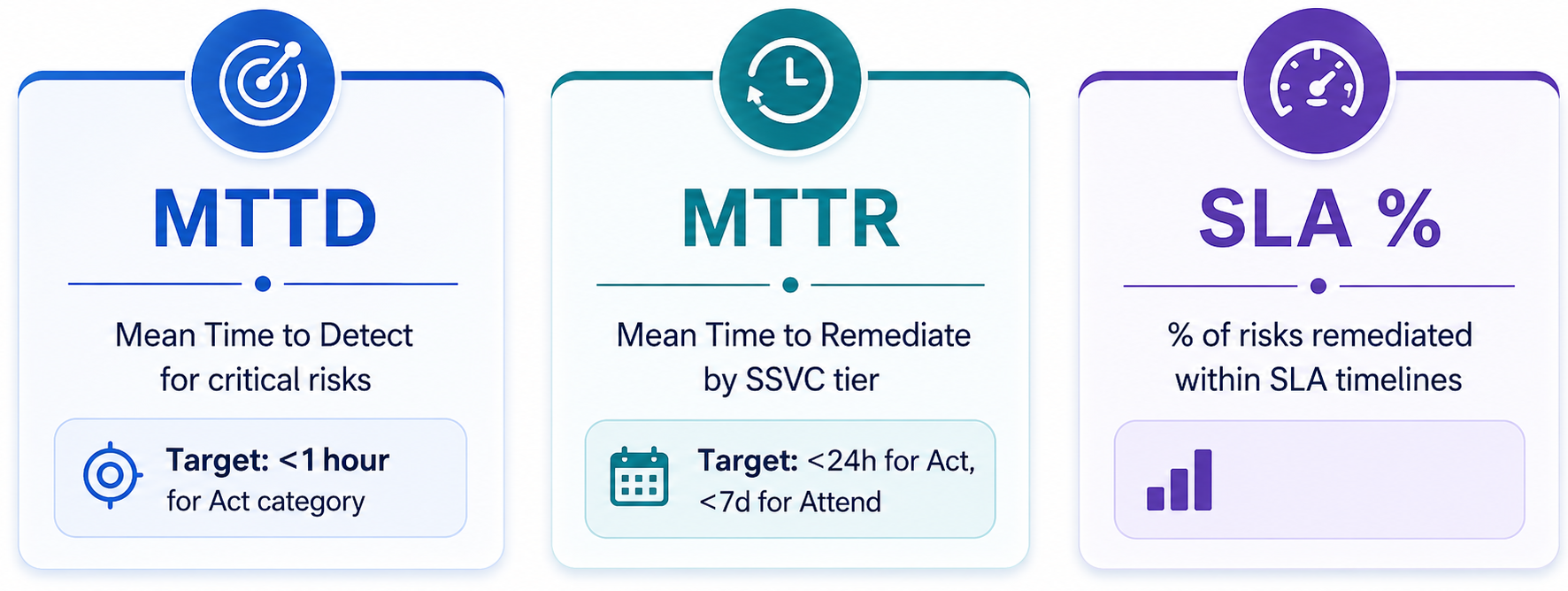
The risk prioritization program must quantify what it finds into meaningful business terms and Saner CSRP's scoring architecture is built precisely for this.
When a risk carries a CCSS Base Score of 9.80/10, an Exploitation Probability of 5.90/10, a Total technical impact classification, and sits on an Essential business-centric resource that is publicly accessible, you are no longer dealing with an theoretical security issue.
You are looking at a risk that, if exploited, gives an attacker full control over infrastructure having your most operationally critical data.
This is a business risk CCoE can put in front of a business unit leader or board without translation.
That is the conversation that gets remediation prioritized at the right level, by the right people, with the right urgency.
What Separates Good Cloud Risk Prioritization from Great
Good prioritization ranks your existing findings better.
Great prioritization prevents findings from occurring in the first place because it has embedded SSVC-based risk scoring, MITRE ATT&CK context, and mission prevalence tagging into every stage of the cloud.
When a developer provisions a new workload, the risk classification follows automatically. When a risk appears, it contextualizes by who it affects, how an attacker would exploit it, and what the organization needs to do about it at the governance level.
That is the organizational outcome a mature cloud risk prioritization program delivers.
The dashboard shows fewer real risks in your cloud environment and CCoE that can report that posture to auditors, regulators, and business leadership with full confidence.
Schedule a demo on Saner Cloud Security Risk Prioritization
Prioritize risk based on real exploitability and business impact, not just raw severity scores, so security teams fix what actually matters first.


