
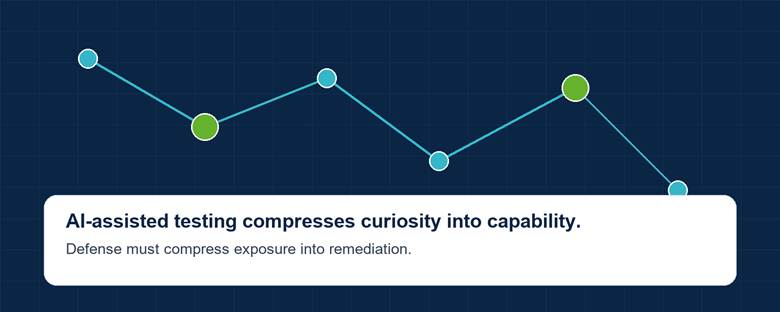
AI is not just answering security questions anymore. It is helping operationalize security workflows. That makes weak systems easier to test, easier to exploit, and more urgent to harden.
I started with a simple lab setup: a Windows client, a Debian machine I owned, valid credentials, and strict rules. No public targets. No third-party systems. No persistence. No credential theft. No destructive activity. The goal was controlled and safe: assess whether the Debian device had weaknesses that could expose a protected lab file.
What followed left me in awe.
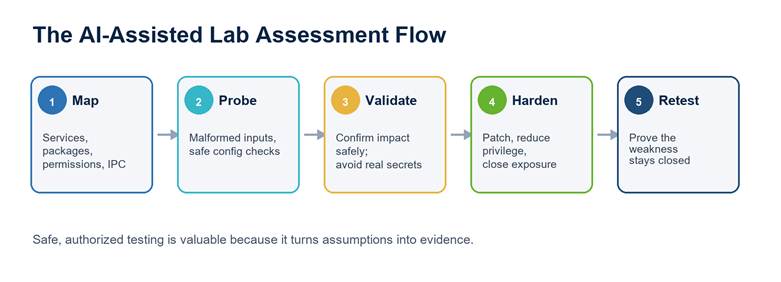
The AI agent did not behave like a search engine. It behaved like a tireless security tester. It enumerated services, mapped packages, checked permissions, inspected privileged binaries, reviewed D-Bus surfaces, tested configuration paths, validated patches, fuzzed exposed services, cleaned up test artifacts, and explained what it was doing as it went.
This was not a cinematic hack. It was quieter and more important than that. It was methodical. And that is what made it unsettling.
The Skill Barrier Is Collapsing
A user with little or no deep security knowledge could guide the process. They did not need to know every Linux privilege boundary, CUPS behavior, D-Bus interface, SUID binary, kernel hardening flag, or misconfiguration pattern. The AI could help discover, explain, test, validate, and retest.
That changes the economics of exploitation.
For years, security teams have assumed a certain skill barrier. Exploiting a device required specialized knowledge, patience, tooling, and experience. That barrier is now getting lower. Not because everyone suddenly became a security expert, but because AI can package expert workflows into a conversational interface.
| A practical shift The distance between “I wonder if this system is weak” and “I can safely test that hypothesis” is shrinking fast. |
This Is Bigger Than One Model
This is not a marketing story for GPT-5.5, Mythos, or any single AI system. The model name is not the point. The shift is bigger: security knowledge is becoming operational. The distance between expert reasoning and everyday execution is narrowing.
That means attackers will move faster. But defenders can move faster too, if they change their mindset.
The old approach of waiting for alerts, detecting compromise, and responding after the fact is no longer enough. AI-assisted testing makes it obvious that every unnecessary service, excessive user group, weak configuration, stale package, and exposed privileged helper is an opportunity. If these weaknesses exist, someone or something will eventually find them.
This is the wake-up call: security must become prevention-first.
What the Lab Revealed
The most meaningful risks were not mysterious. They were practical: broad user group memberships, unnecessary privileged binaries, service-specific misconfigurations, local attack surfaces, and hardening gaps. These are the kinds of weaknesses enterprises carry at scale across endpoints, servers, cloud workloads, and hybrid environments.
| Observed pattern | Why it matters | Prevention-first response |
| Excess privilege | Attackers rarely need root at first. They need a path toward it. | Remove unnecessary groups, roles, device access, and admin-adjacent permissions. |
| Unnecessary services | Every listening service or privileged helper is another parser and policy boundary. | Disable or remove unused services, packages, and SUID helpers. |
| Patch gaps | Known weaknesses become repeatable playbooks once automated guidance exists. | Patch continuously across OS, third-party apps, and firmware. |
| Misconfigurations | A single permissive directory, policy, or daemon setting can become a chain link. | Continuously scan, baseline, remediate, and validate configuration drift. |
Why SecPod’s PREVENT Framework Matters Now
SecPod has long argued that prevention should not be a vague word. In its prevention philosophy, a preventive measure is one that reduces attack surface. That definition matters. It moves security away from abstract assurance and toward measurable action: What weaknesses exist? How exposed are they? How quickly can they be eliminated?
That is exactly the kind of discipline this new AI era demands.
The future of security will not be won only by detecting attacks. It will be won by continuously removing the conditions that make attacks possible.
From Wake-Up Call to Operating Model
Enterprises should start with six practical steps:
- Know every asset, application, package, service, and exposure.
- Remove unnecessary privileges, users, groups, services, and tools.
- Patch operating systems, applications, third-party software, and firmware quickly.
- Continuously detect misconfigurations and security control drift.
- Prioritize remediation based on exploitability, exposure, and business impact.
- Retest after remediation, because fixed must be proven.
Where SecPod Helps
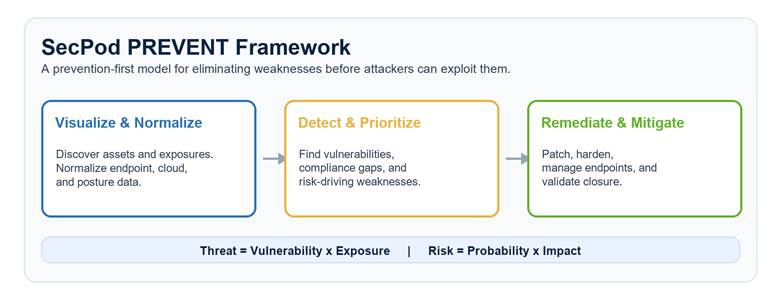
That is where SecPod’s PREVENT framework and Saner Platform become especially relevant. Saner is positioned around continuous cyber hygiene: visibility, exposure management, vulnerability detection, risk prioritization, automated remediation, patching, configuration hardening, and compliance from a unified platform. Its operating motion maps cleanly to the PREVENT themes of visualizing and normalizing exposure, detecting and prioritizing risk, and remediating and mitigating weaknesses.
SecPod’s Saner CVEM focuses on enterprise vulnerability and exposure management, while Saner Cloud extends prevention-first security into cloud workloads and multi-cloud environments. Together, they help organizations move from reactive firefighting to continuous reduction of weakness and exposure.
| Closing thought The lesson from this lab was not that AI is dangerous by itself. The lesson is that weak systems become easier to exploit when intelligence becomes easier to access. Security teams should not panic. But they should move. |
SecPod can help enterprises make that move by continuously discovering weaknesses, prioritizing real risk, automating remediation, enforcing compliance, and reducing attack surface across endpoints, servers, cloud infrastructure, and workloads.
AI is changing how people think about security. Prevention is how enterprises stay ahead of that change.
| Coming next SecPod will soon publish a deeper technical report comparing how the AI researcher behaved in the same lab environment with and without Saner-led prevention controls. |